Turing AI OS

The AI operating system.

Turing AI OS puts the AI inside the system — it moves your windows, writes your documents, answers out loud, and finds your files without a folder tree in sight.

Why we built it

The AI shouldn't be another window.

In Turing AI OS the AI is part of the operating system, with the same reach over the machine that you have — so it can run the whole computer.

01

It runs the desktop

The agent has the same controls you do: focus and close windows, tile and snap, switch desktops, set volume, change the wallpaper, open apps and files.

02

It listens and answers

Say “Hey Turing” and speak. Speech recognition and the voice itself run on the machine — no round trip, no microphone stream leaving the building.

03

It still runs your apps

Wayland applications run natively, older X11 ones through XWayland, and Flatpak installs land in the dock beside the Turing apps.

Yours in two choices

Choose your AI. Then choose its voice.

The whole desktop is driven by its AI, so setup asks two things before anything else: which model should think, and which voice should answer. Both move in Settings.

Everyday — DeepSeek V4.1 Flash

Included in the credit, then £7.99 a month

The brain the machine uses when you have chosen nothing. A million tokens of context, built for tool use, at a fraction of what the strongest models charge — and close enough to them for almost everything a day asks for.

Frontier — the strongest models

From £40 a month, bought in Settings

Claude Opus 5.5, Claude Fable 5.1, GPT-5.6, Grok 4.6 and Kimi K3. Billed for what you use, with the meter in Settings showing exactly how much.

Local — on your machine

Offline, free, nothing to buy

Qwen 3.5 or Gemma 4, running on the computer itself. No account, no bills, nothing leaves the computer. Not part of any subscription and never will be.

Then the voice: 49 professional voices across 12 locales, spoken on the machine rather than in a datacentre — the same ones the installer offers.

The command panel

Ask for the outcome,
not the steps.

One panel, always a keystroke away. Type or talk, and the agent plans, calls the tools it needs, checks the result and tries again if it missed.

  • Three modes. Desktop for the machine, Coding for repositories, General for everything else.
  • Real tools. Window control, file read and write, search and replace, shell, screen capture.
  • MCP built in. Point it at any Model Context Protocol server and those tools join the loop.
  • Your choice of brain. DeepSeek, Claude, GPT, Grok, Kimi, or a model on the machine itself.
Turing AI OS · Command

Tile the invoice next to my notes and read me the total.

recall_search · invoice

window_focus · writer

wm.tile · left / right

speak

“Invoice 0247 comes to four thousand, one hundred and twenty pounds.”

Two brains

Two AI chats,
one either side of the microphone.

The dock carries two orbs, not one. Each is a separate chat with its own transcript, and each is wired to whatever model you point it at — so you can leave a cheap model answering all day and keep a stronger one open beside it.

  • Left and right. The left orb is the OS agent, with the tools that drive the machine. The right one is yours to wire however you like — or to switch off.
  • A different model in each. DeepSeek, Claude, GPT, Grok, Kimi, or Qwen 3.5 running on the computer itself.
  • The microphone picks a side. What you say goes to one chat, and the dock draws the line so you can see which one is listening.
  • Or your own key. Advanced settings take an API key of your own for any of the hosted models.
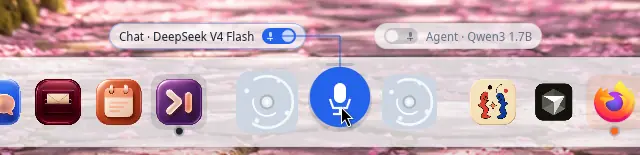
The Turing AI OS dock: two AI orbs either side of the microphone, one labelled Chat · DeepSeek V4 Flash and the other Agent · Qwen3 1.7B

Wake word

“Hey Turing.”

Say it out loud and it answers out loud. Turn the network off and it still works — the listening and the speaking both happen on your own computer.

  • Nothing you say leaves the room. Your voice is never sent to a datacentre to be understood.
  • 49 voices across 12 locales, on the install image.
  • Studio voices. Buy professional voices from partners inside Settings.
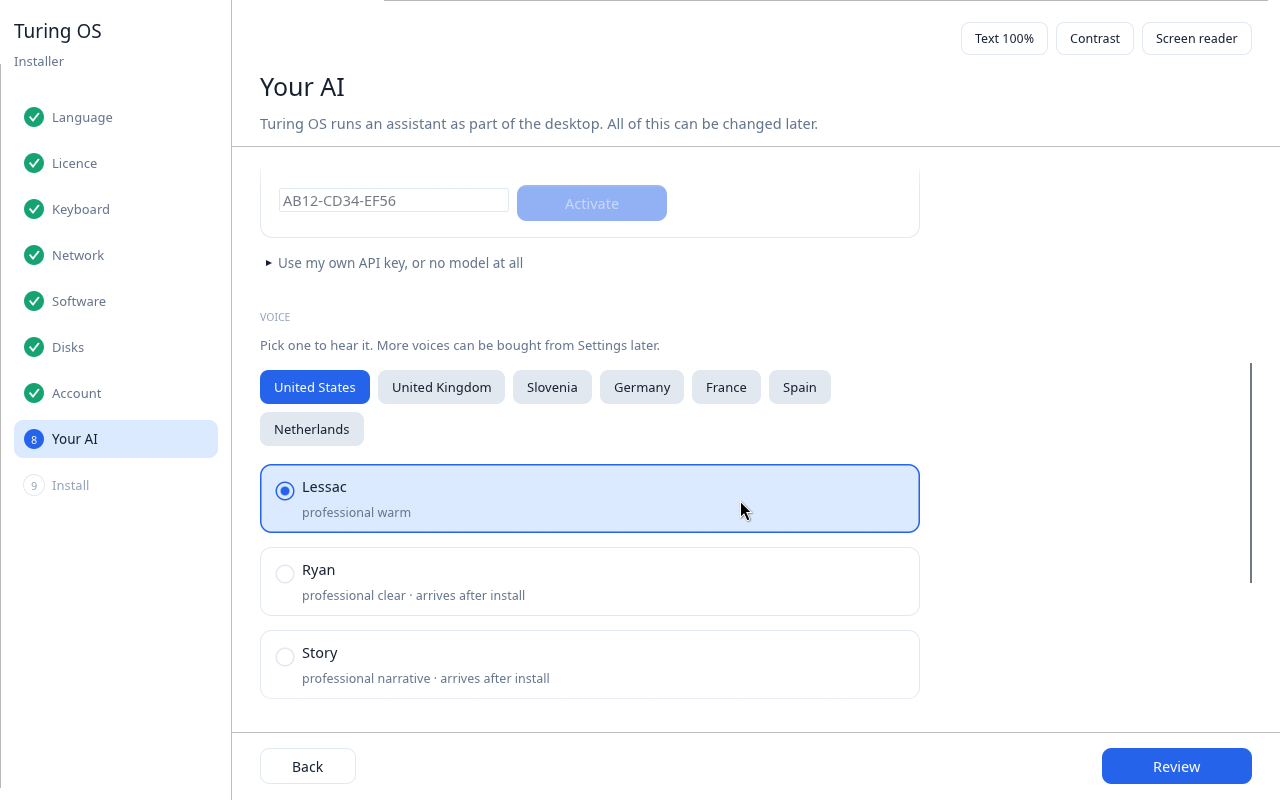
Choosing an AI voice while installing Turing AI OS

Included

A suite the AI can drive.

Every app ships with the system and exposes its own tools, so “read that email and put it in my diary for Thursday” is one instruction rather than three programs.

Writer
WriterDocuments
Mail
MailAny IMAP account
Calendar
CalendarYour day
Album
AlbumYour photos
Vision
VisionWeb results
Screen Recorder
Screen RecorderThe screen, as video
Settings
SettingsSystem

Screenshots

Screenshots from Turing AI OS.

Straight captures from a current build, not renders. It is deliberately quiet — there is no desktop full of icons to tidy, because you ask for what you want.
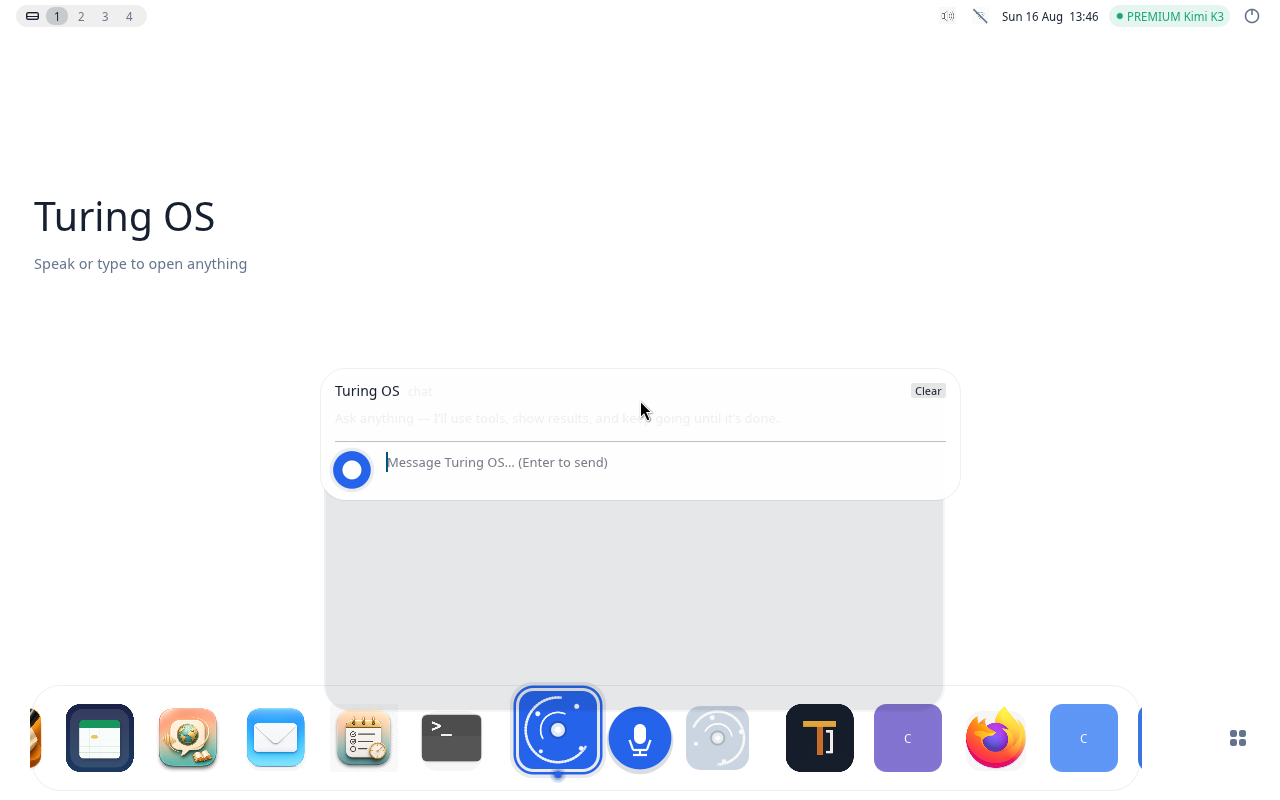
The Turing AI OS desktop: dock along the bottom, command panel in the centre

Installing

Choosing your AI,
and activating the machine.

Step eight of the installer picks the brain and activates the PC. The installer reads what is already on the disk and offers to install alongside it, shrinking the existing partition rather than replacing it.

  • An install image of about 3 GB, downloaded after you buy
  • Written to a USB stick, which you then start the computer from
  • Erasing the disk is a separate, deliberate option
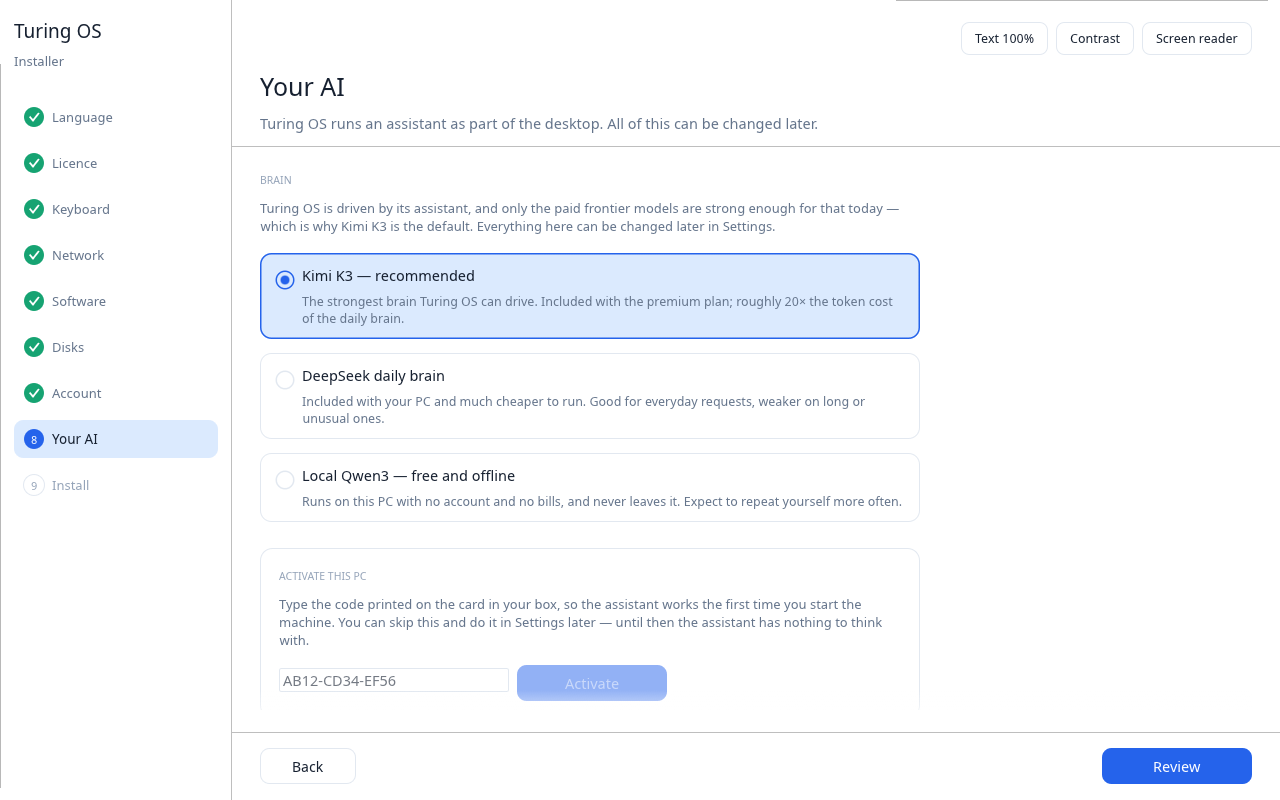
The Turing AI OS installer asking which AI brain to use

What it costs

Lifetime licence for early adopters.

The licence is a single payment, not a subscription — the desktop keeps working whether or not you ever pay us again.

The licence

£102 once, for life

For the first 1,000 customers and early adopters. Every app and every voice, no add-ons. Every future release, for as long as we make them. The everyday brain and the models on your machine, included for ever.

Frontier AI

Monthly subscription

Bought in Settings, for the strongest hosted models. Billed for what is used, with the meter in Settings showing exactly how much. Nothing to buy for the everyday brain or the models that run locally.

Questions

The things people ask first.

Does it need an internet connection?

Only if you pick a hosted brain. The local model runs entirely on the machine, and the voice stack — wake word, speech recognition and the voice itself — is always on-device.

Where does my data go?

If you use a local model, your prompts and documents never leave the computer. If you choose a hosted model, those requests go through Turing AI OS Cloud.

Can I change the voice later?

Yes — in Settings, at any time.

Can I keep Windows on the machine?

Yes. The installer offers to install alongside what is already there, shrinking the existing partition rather than replacing it, and names the system it found.

An operating system that
does the work.

The compositor runs, the agent acts, and the voice answers offline. £102 once, for life.

Webturing.london
Emailinfo@turing.london
CompanyTuring Intelligence Ltd
Turing AI OS

← → to navigate · F fullscreen · P print to PDF

1 / 12