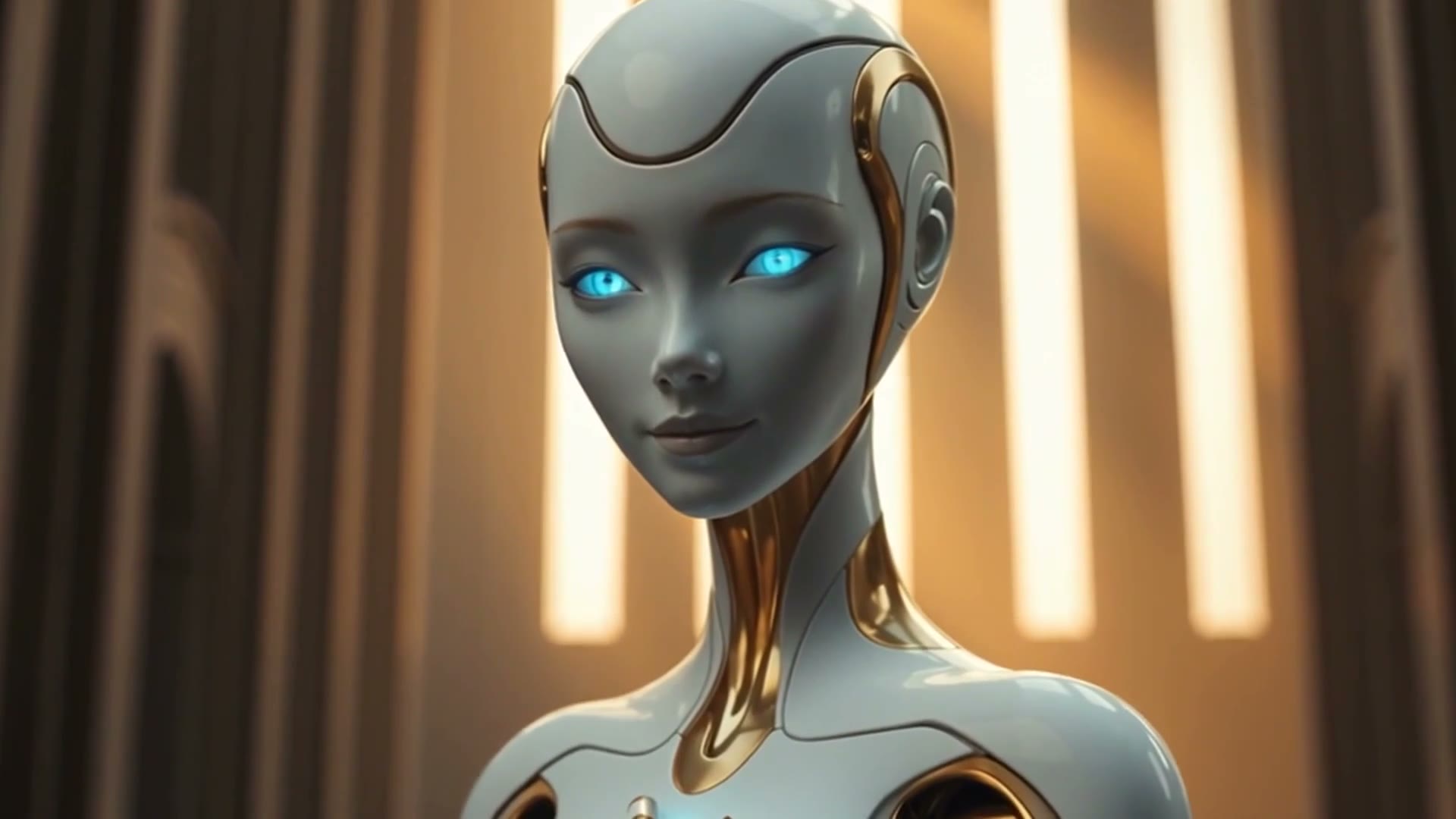
Emma
warm British
“Hello. This is Emma, a warm British voice for Turing AI OS.”

1 / 21
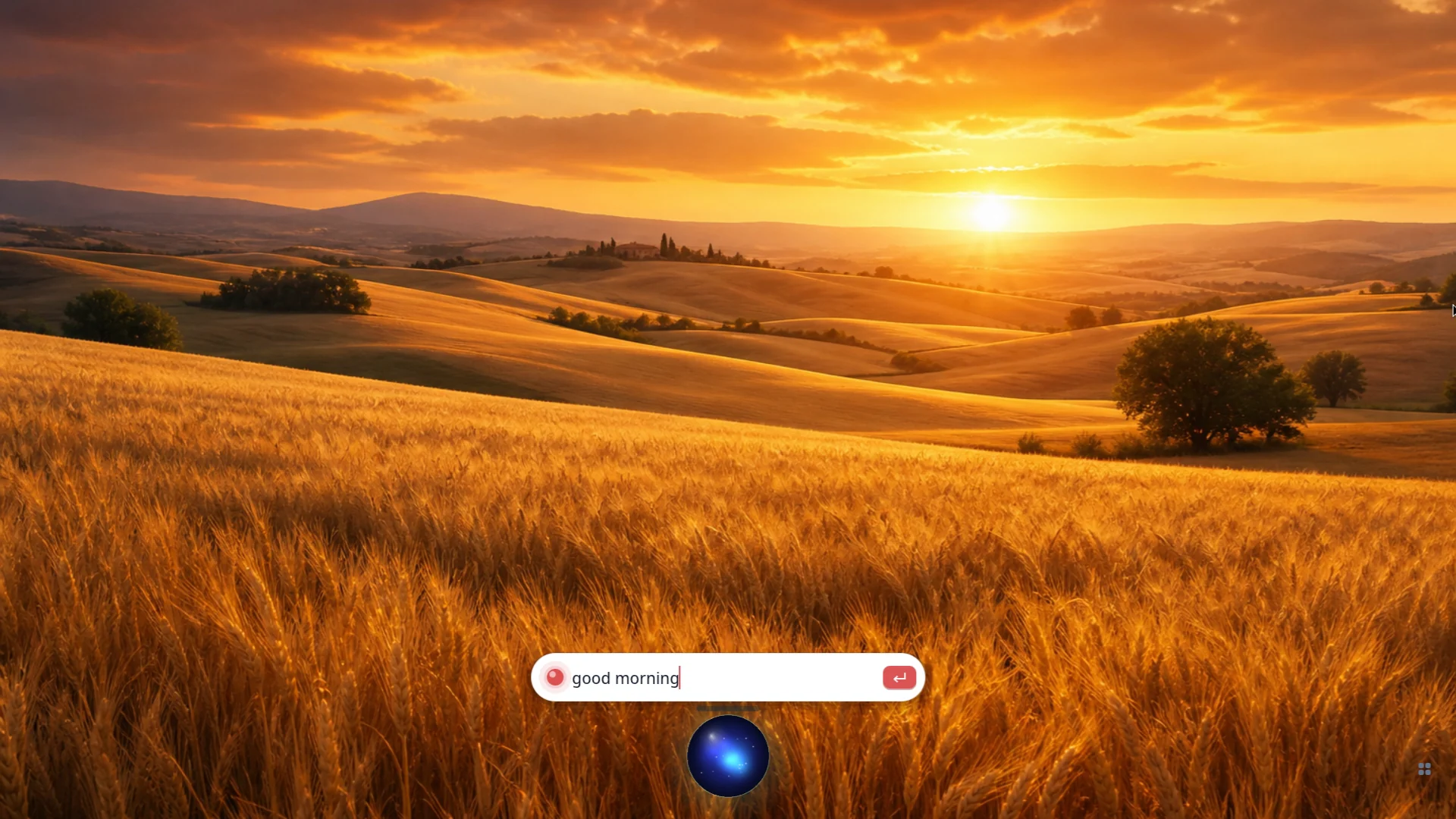
Your wallpaper and one orb, and nothing else in the way. Say the assistant’s name, or click the orb, and ask for what you want.
2 / 21
Tap the Super key and start typing, when you would rather not talk out loud. A line opens above the orb; press Enter and the assistant answers.
3 / 21
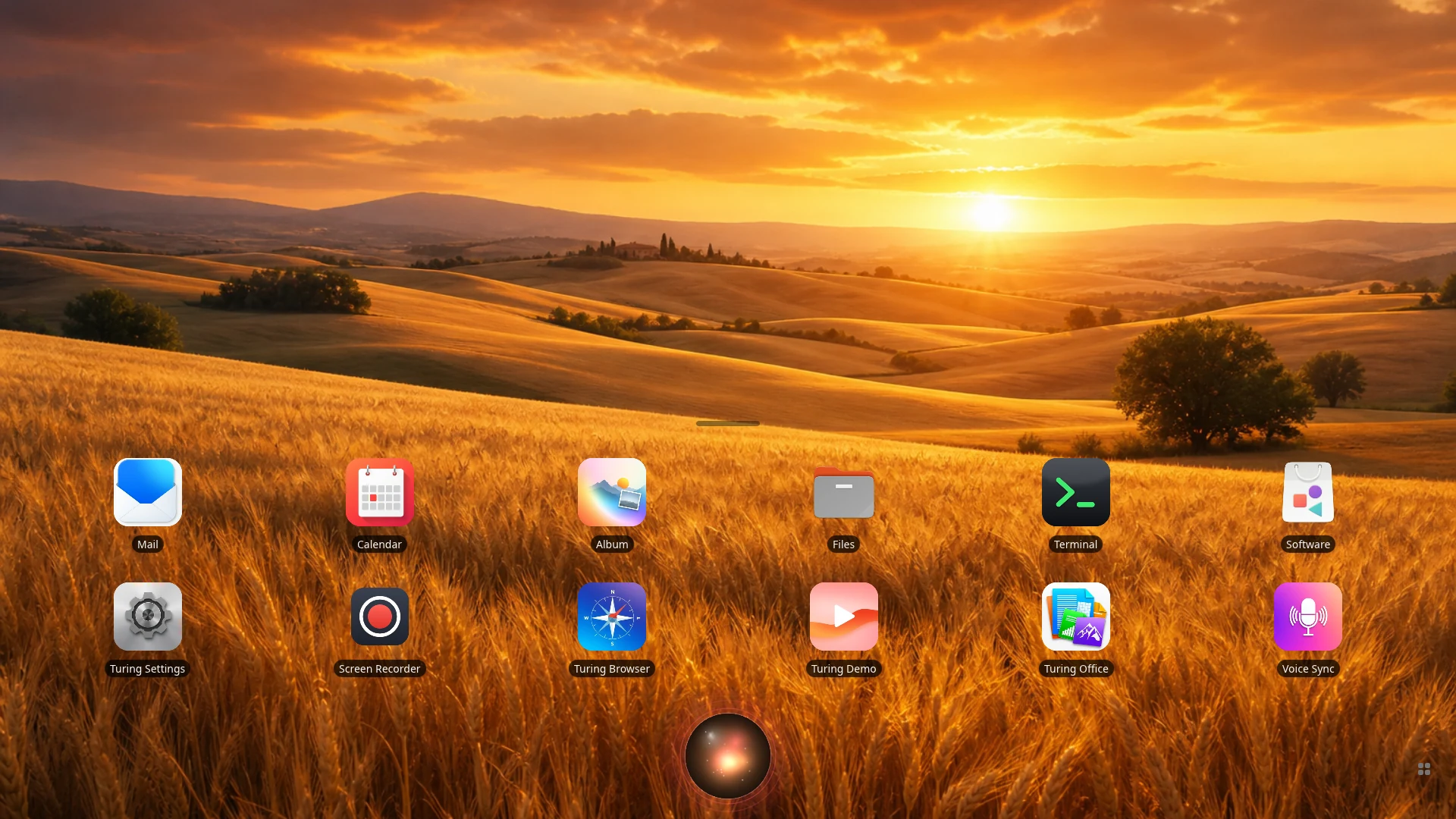
Tap the handle above the orb and the apps you keep to hand stand up over it: Turing Mail, Calendar, Album, Turing Browser, Turing Office and the rest. Open one and the Dock puts itself away again, so the desk stays yours.
4 / 21
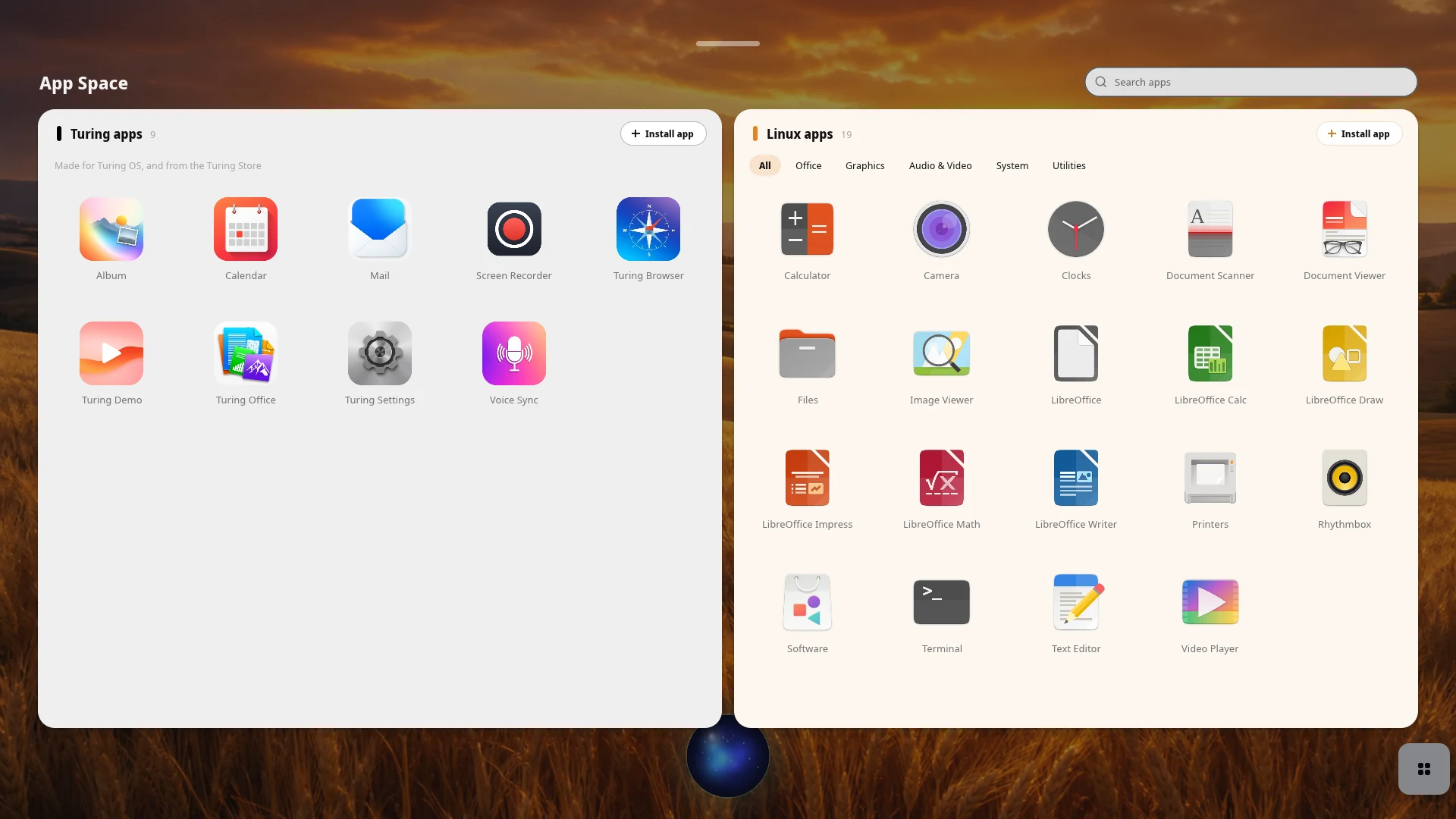
Every app on the computer in one place, opened from the corner of the screen: Turing’s own on the left, Linux apps on the right, sorted by kind, with a search box and a button to install more.
5 / 21
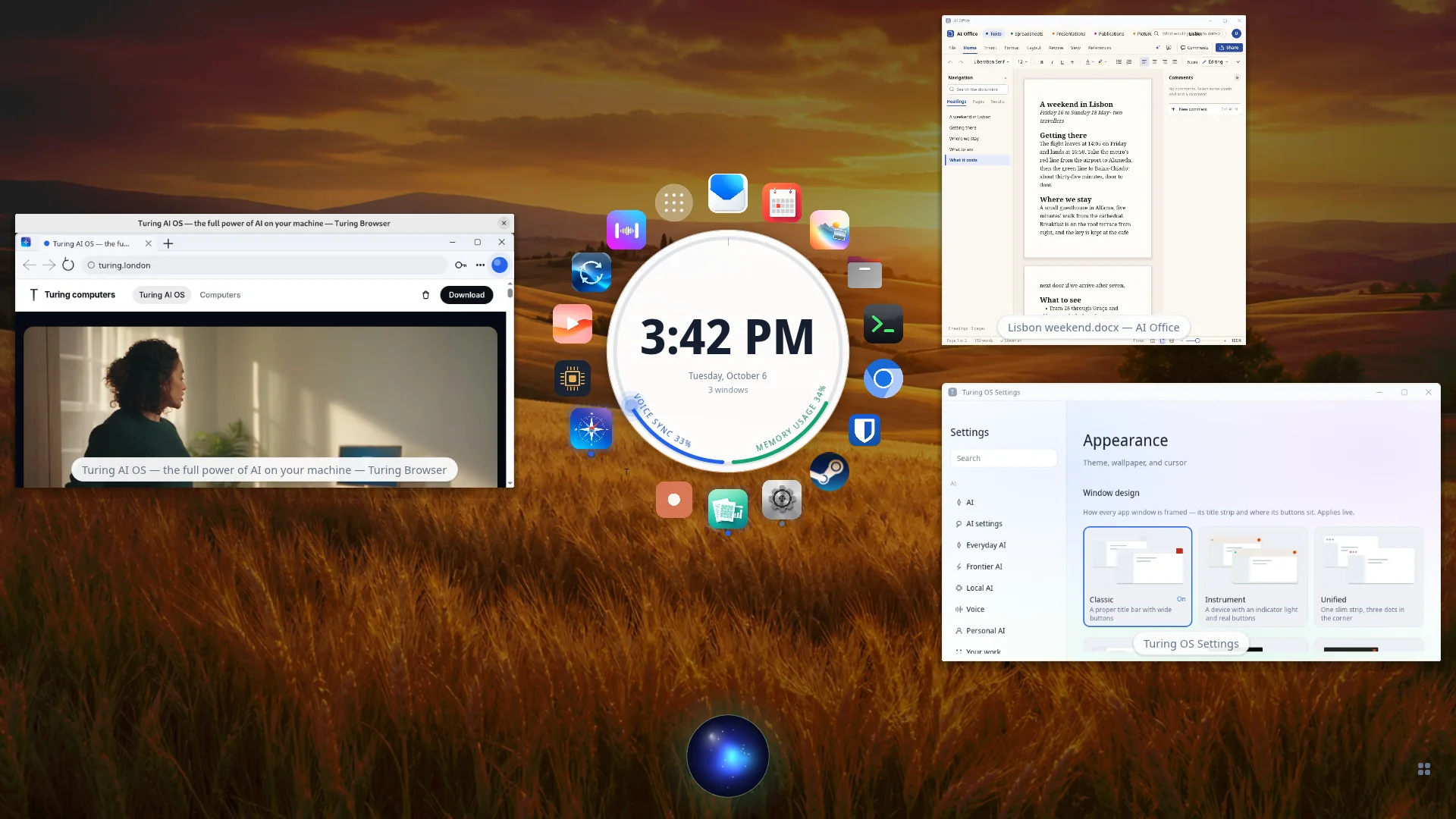
Push the pointer to the bottom of the screen and every open window lays itself out around the clock, with your apps in a ring. A window you have put away waits underneath, small and marked, so nothing is lost. The clock’s rim shows how far Voice Sync has come and how full the disk is.
6 / 21
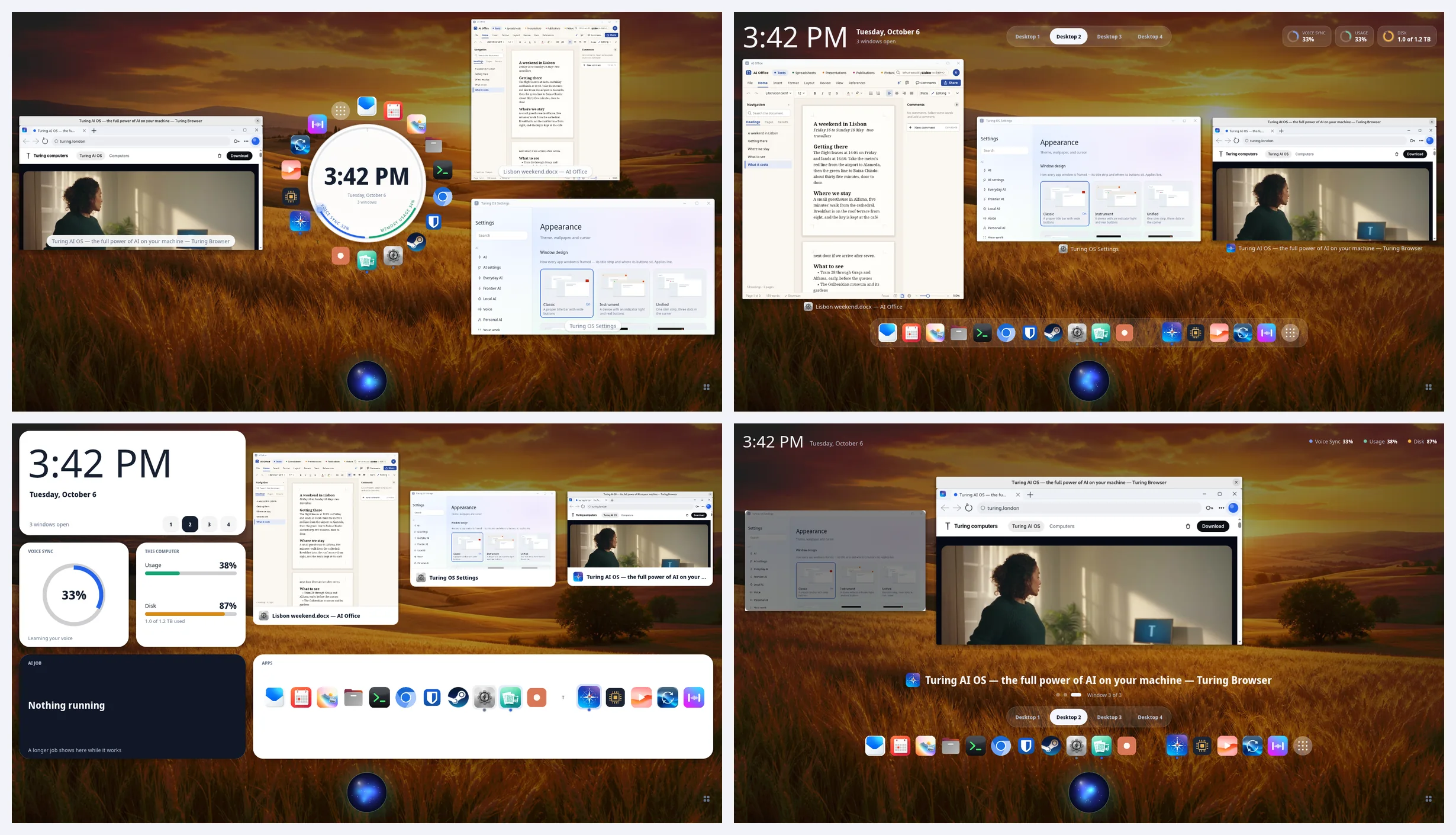
The same three windows in each of the Overview’s designs: Orbit and Stage above, Bento and Carousel below. Choose the one you like in Settings; it changes at once.
7 / 21
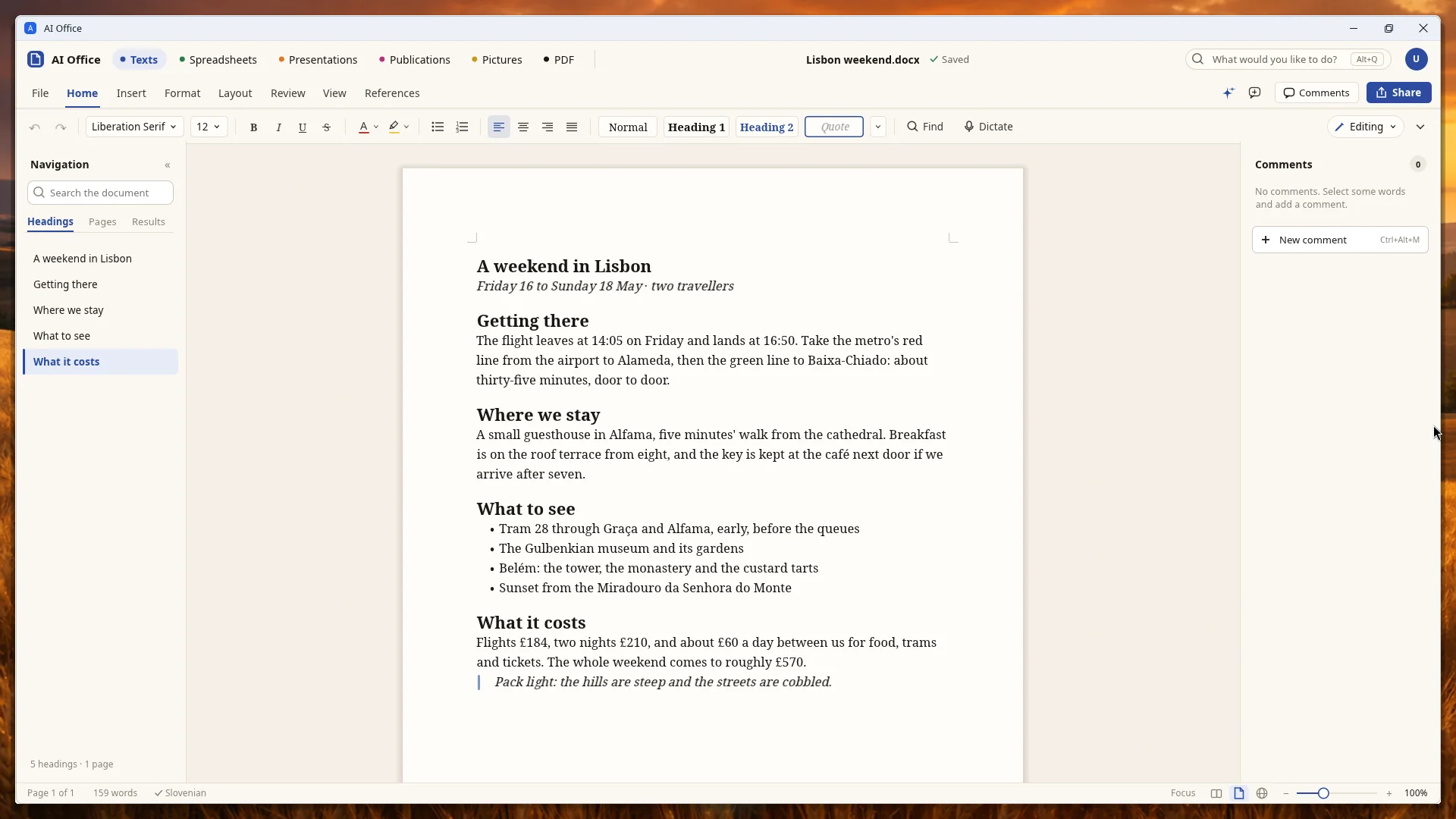
The word processor: headings down the left, comments on the right, and a travel plan in the middle. Every button here is a command the assistant can run, so you can ask for the change instead. Saves as Word, OpenDocument, RTF or PDF.
8 / 21
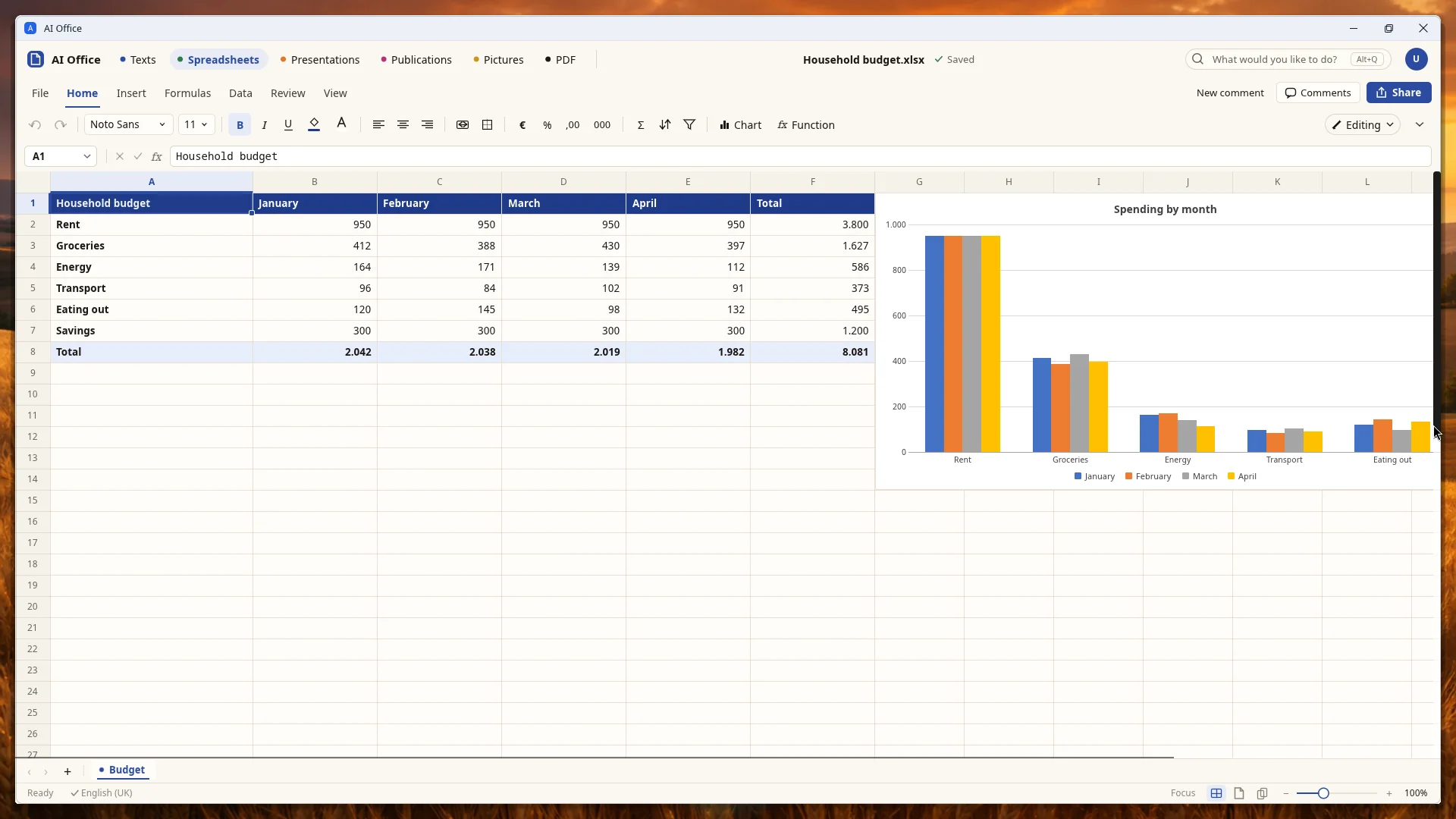
A household budget with its totals worked out by formulas and a chart drawn from the same cells. Opens and saves Excel and OpenDocument spreadsheets.
9 / 21
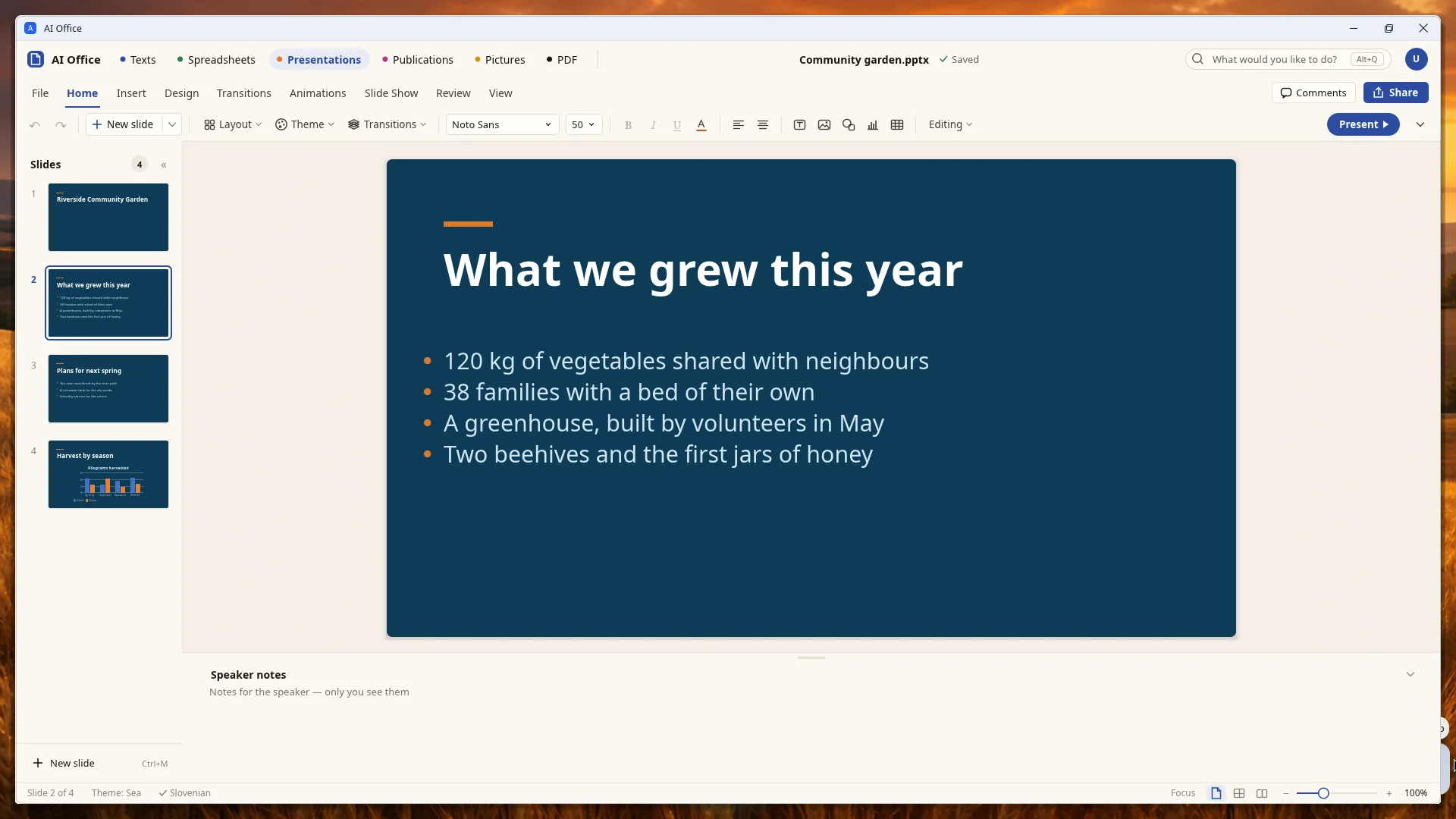
Slides down the left, the one you are working on in the middle, speaker notes underneath, and Present in the corner. Opens and saves PowerPoint files.
10 / 21
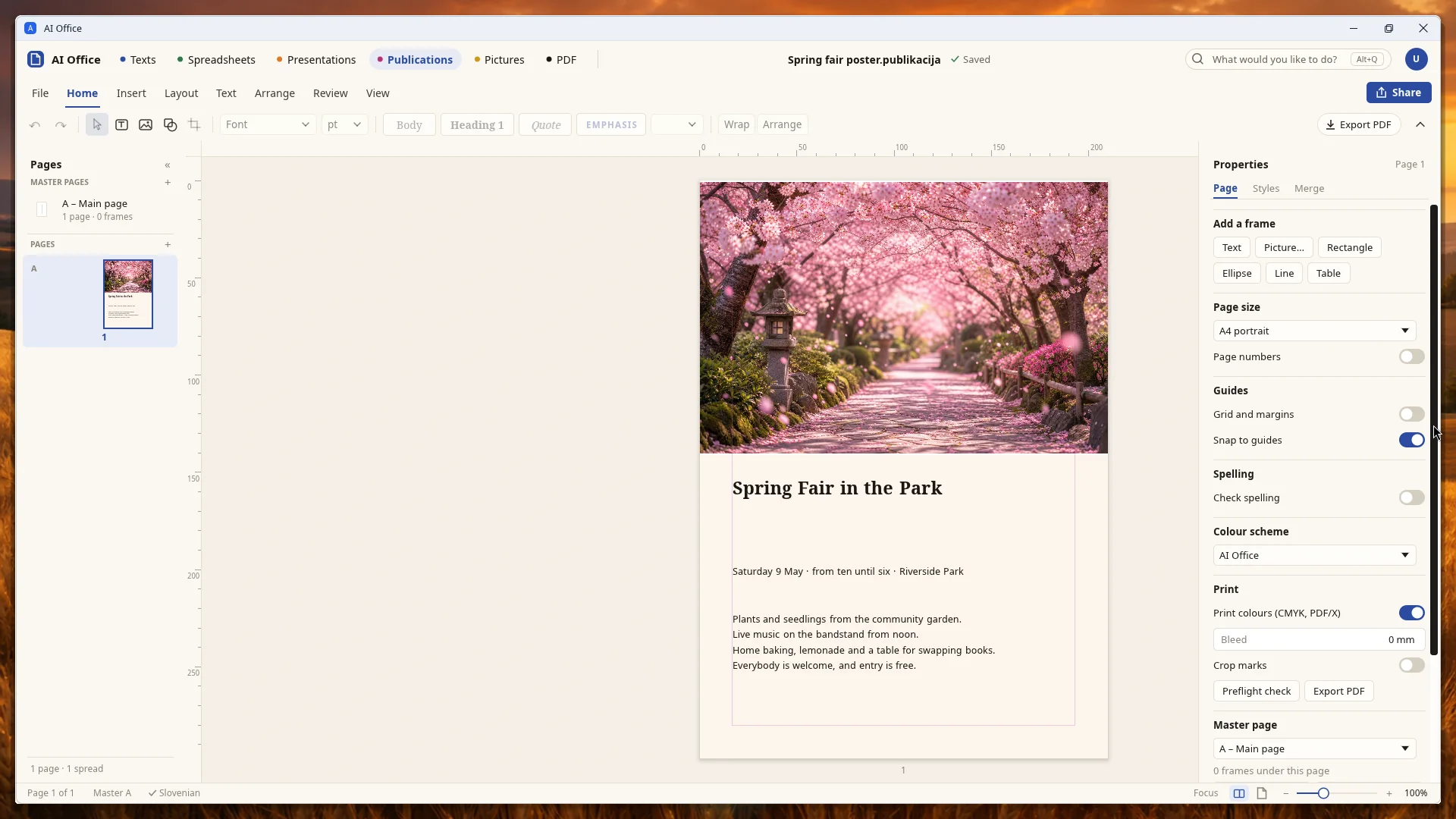
Pages laid out for print: a poster made of a picture frame and text frames, with page size, guides and print colors on the right.
11 / 21
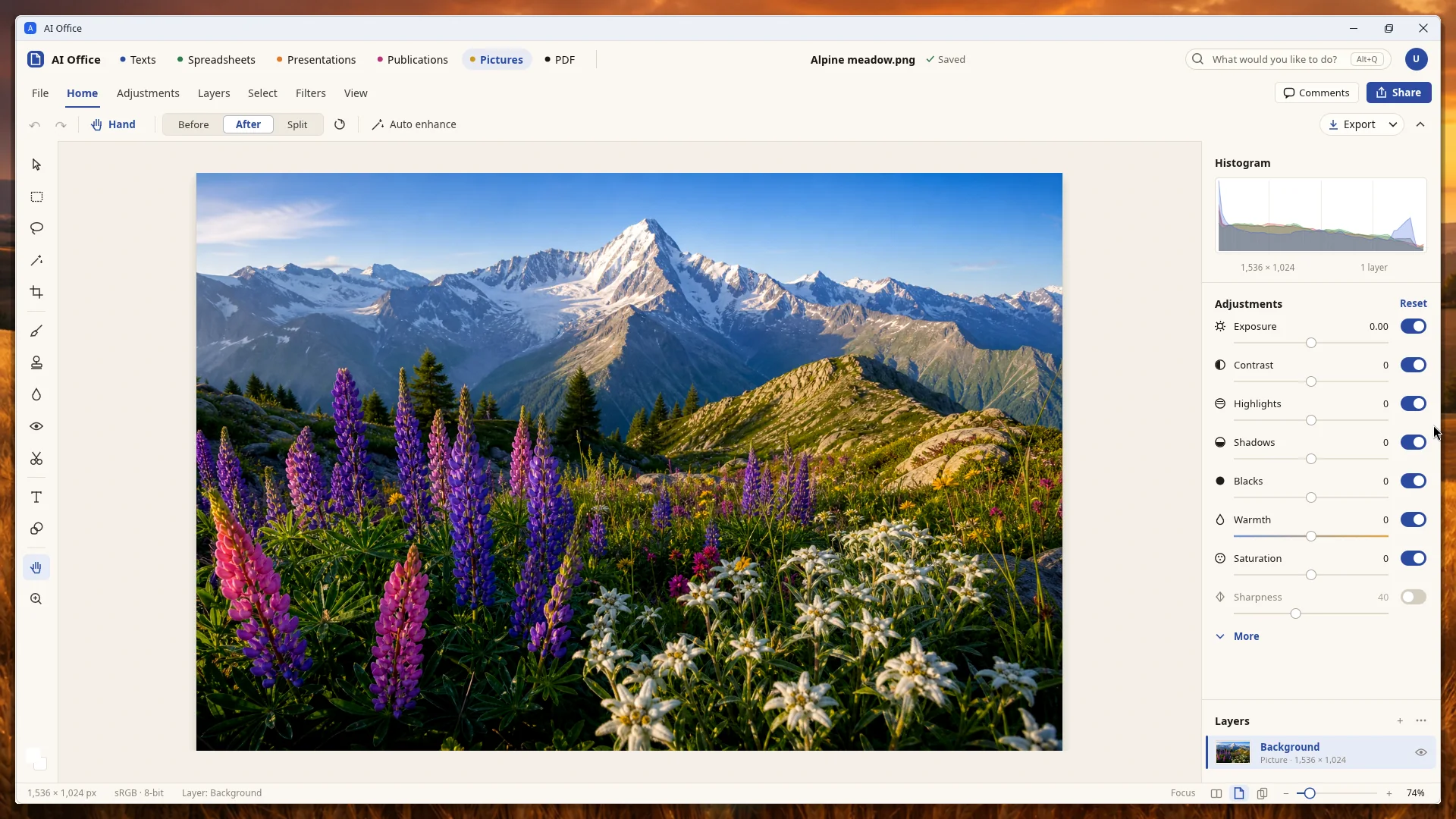
Edit a photograph with layers and adjustments — exposure, contrast, highlights, shadows, warmth — and compare before and after.
12 / 21
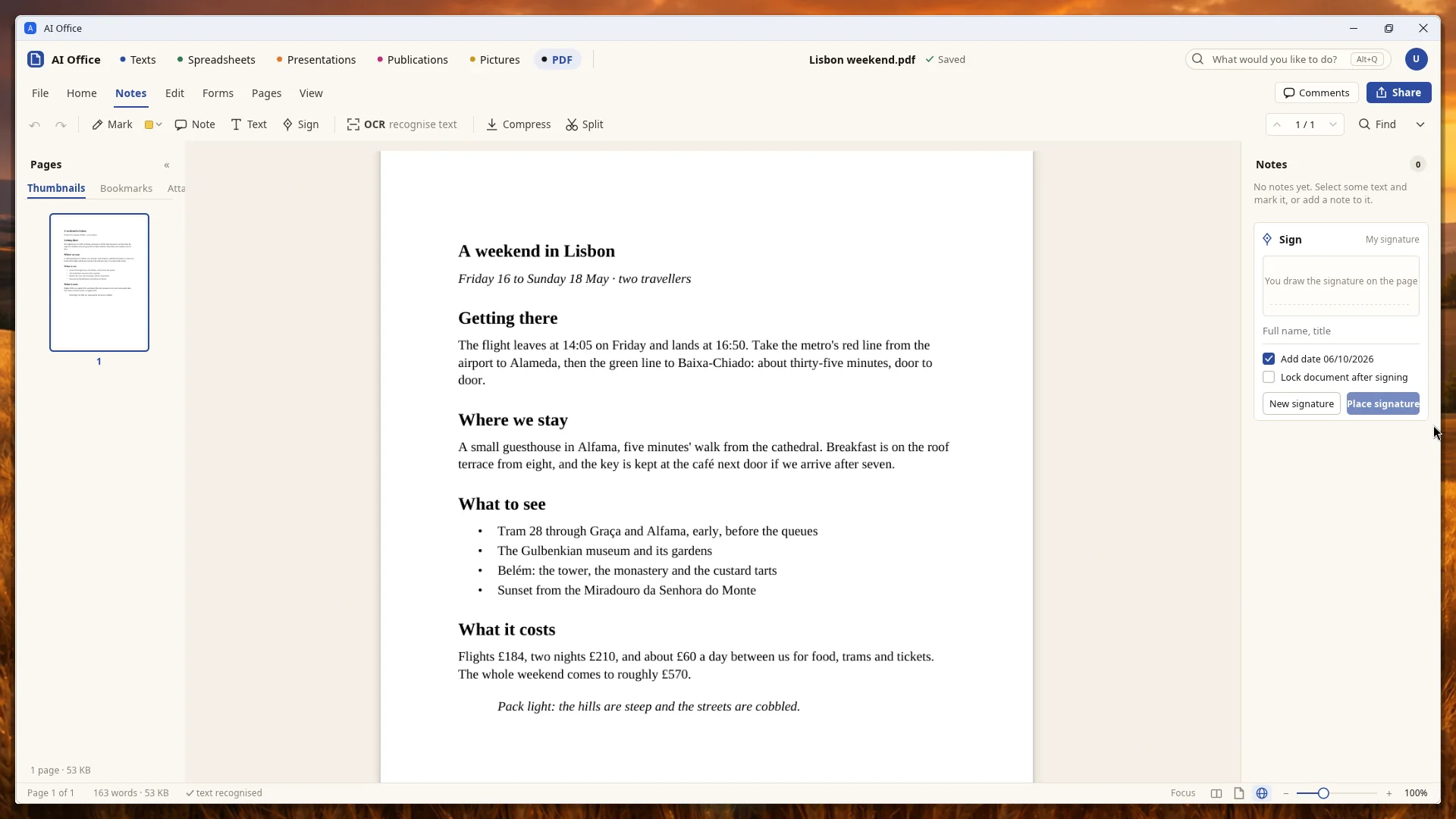
Open a PDF to mark it, add notes or text, sign it, recognize the words in a scan, or split and compress it.
13 / 21
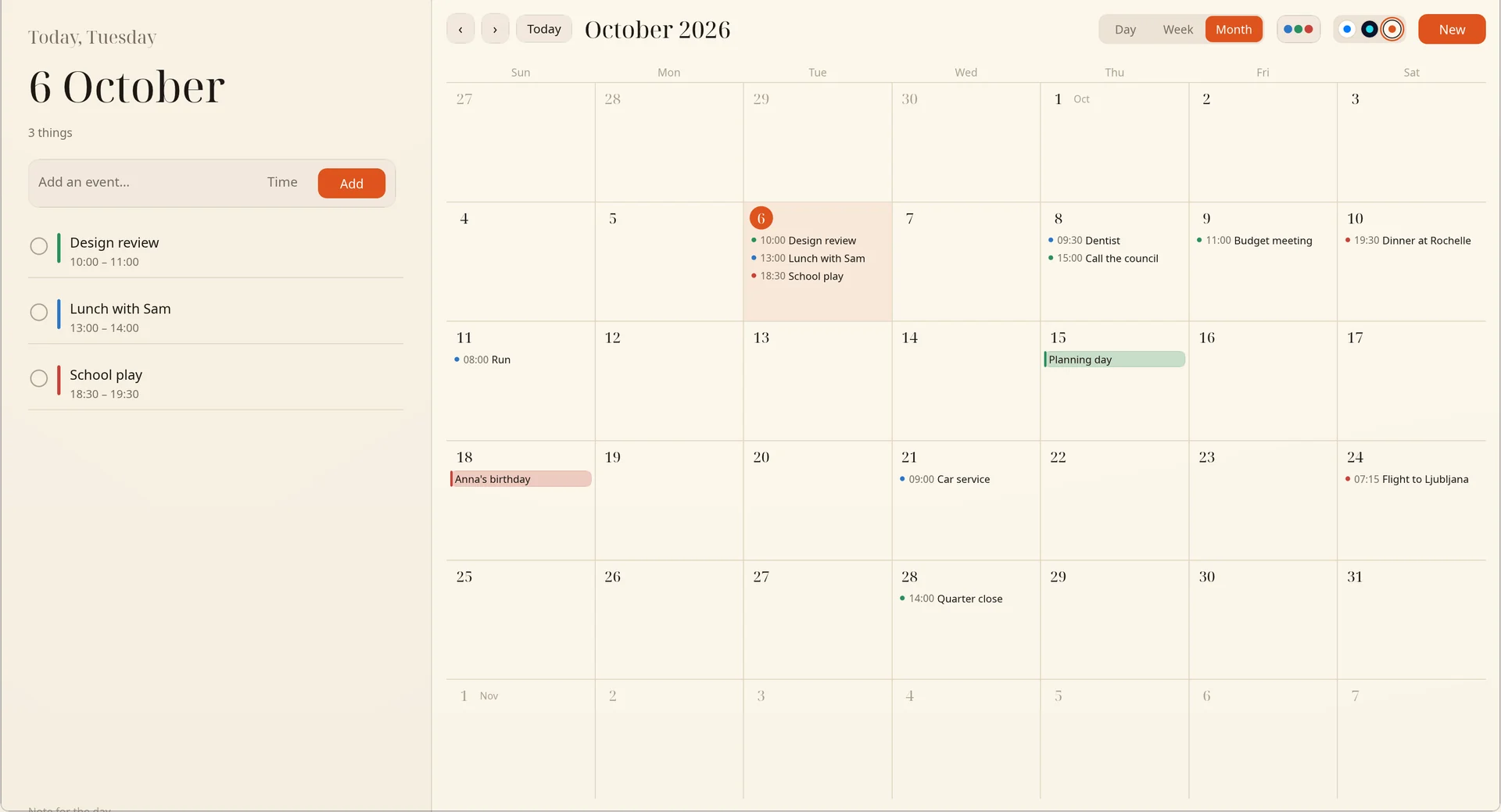
The Paper design: today’s date and agenda set like a printed page, with the month beside it in fine lines. There are two more, Daylight and Dusk. Ask the assistant what is on Thursday, or to move the dentist to Friday.
14 / 21
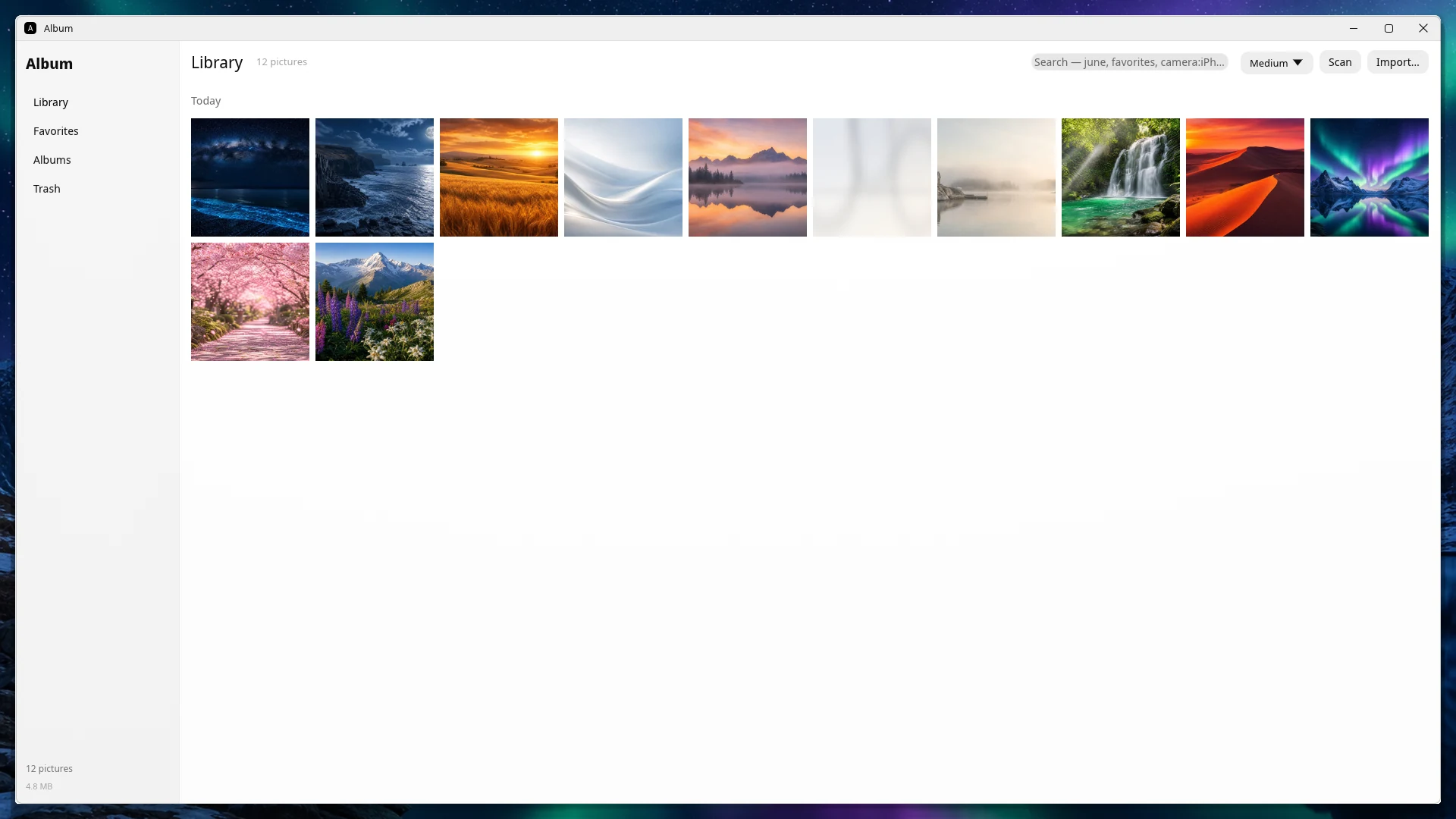
Your photos and albums. They stay on this computer and are never uploaded.
15 / 21
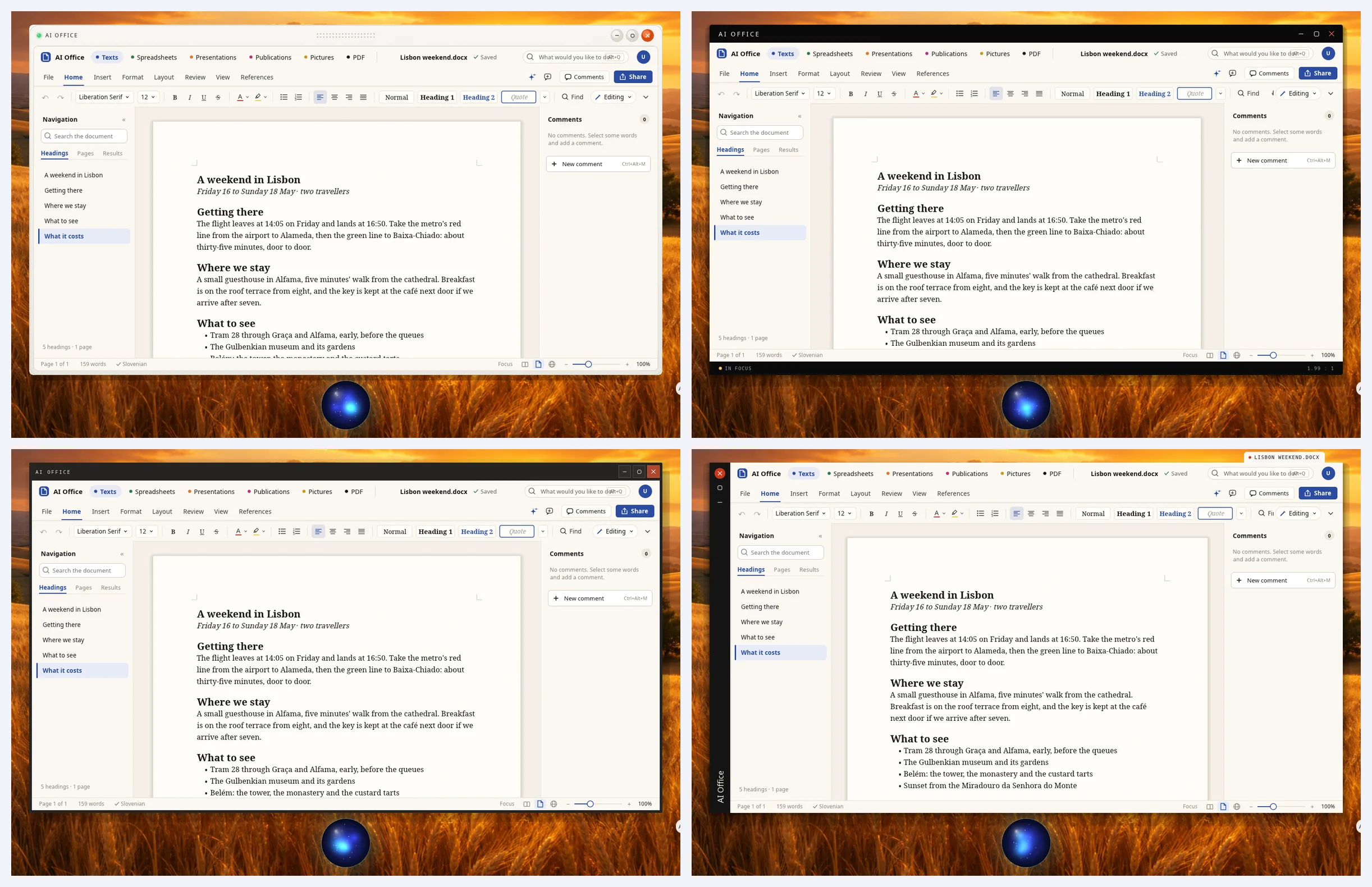
Every window can be framed the way you like it, and the change applies at once. Four of the seven, each on a different part of Turing Office: Classic on a text and Instrument on a spreadsheet above, Unified on a presentation and Mullion on a picture below.
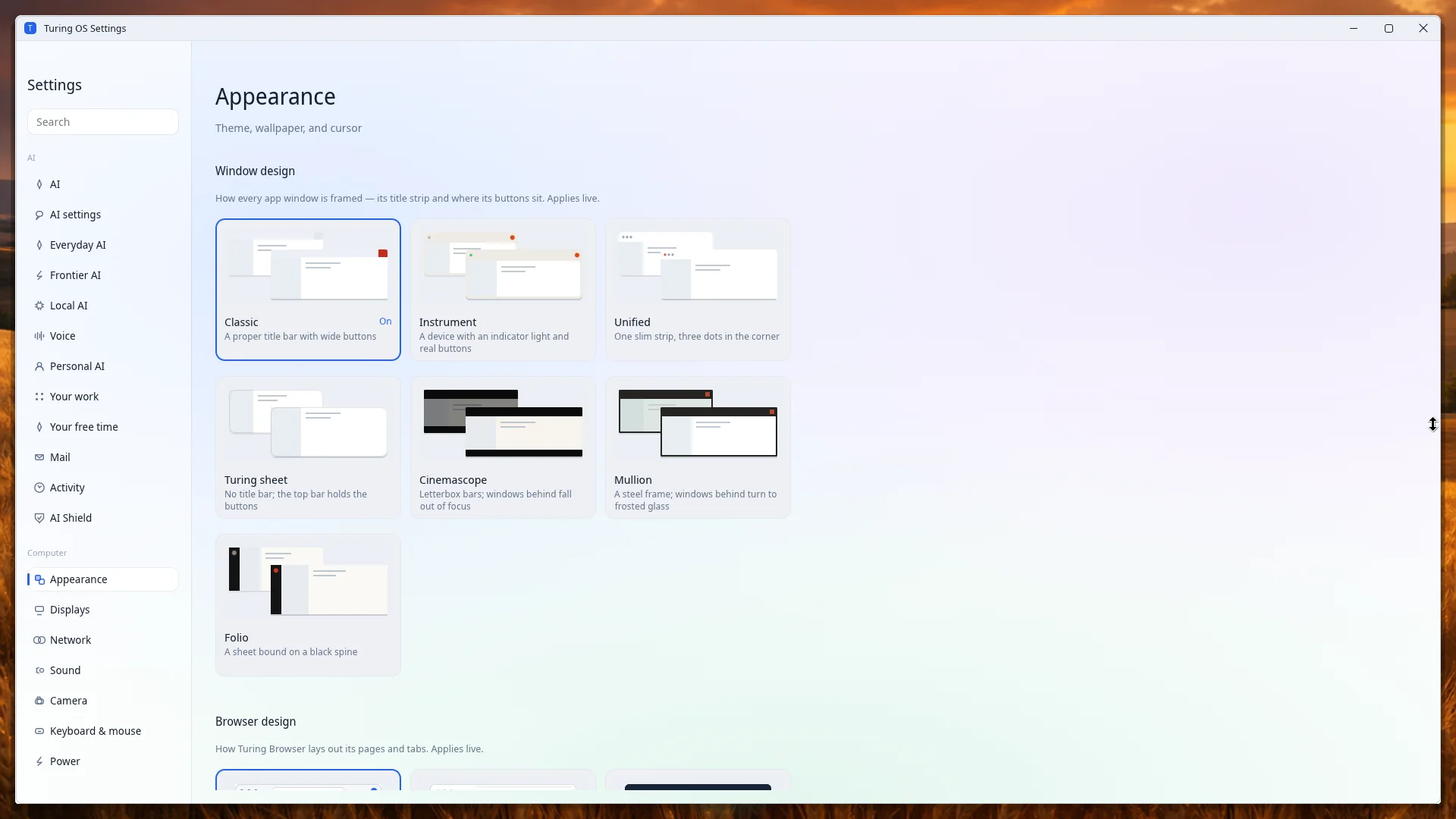
16 / 21
The seven window designs, the browser’s design, the theme, the wallpaper and the cursor, chosen in one place.
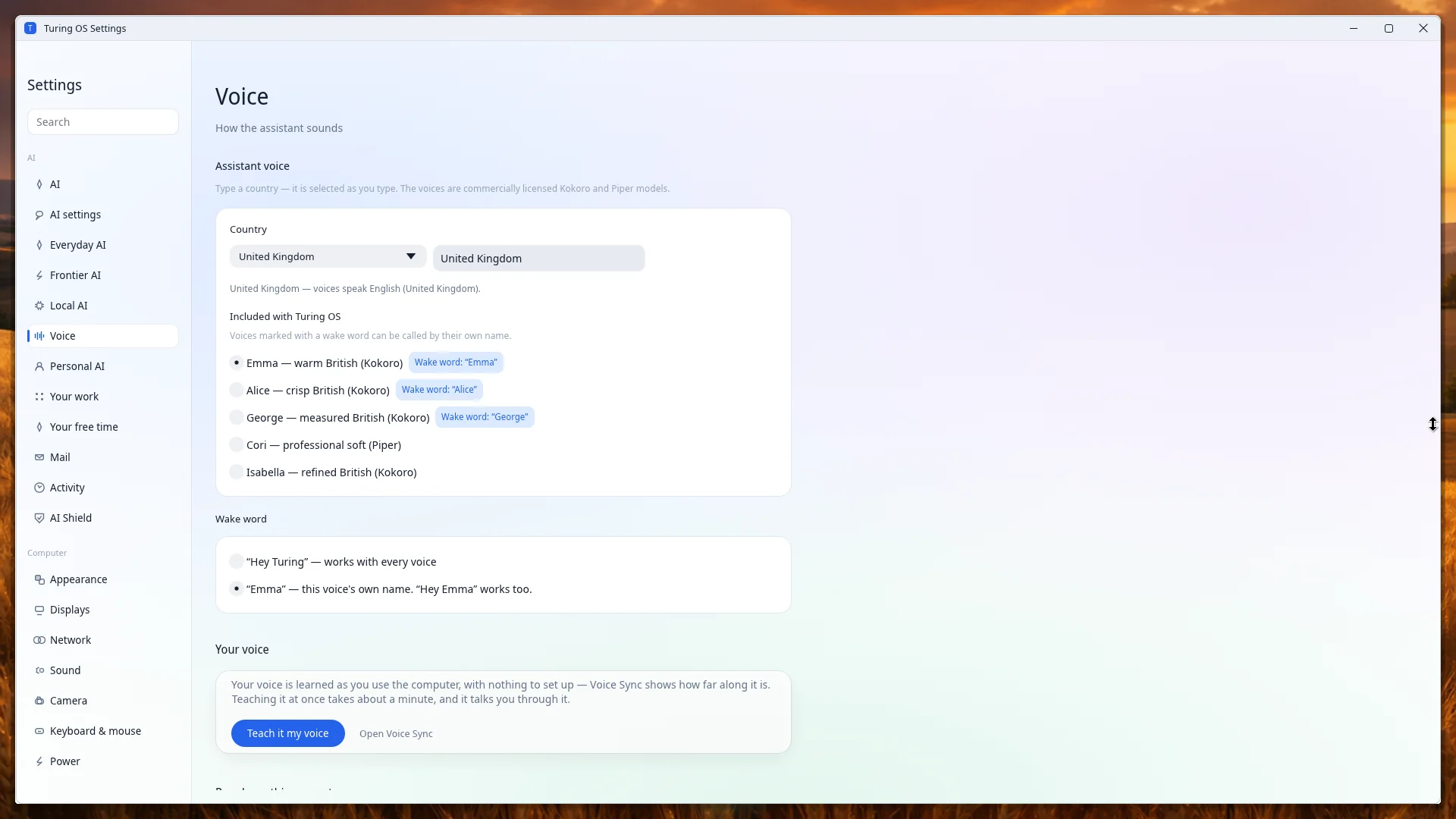
17 / 21
Choose a country and a voice. A voice with a wake word of its own can be called by its name — “Emma” — and “Hey Turing” works with every voice.
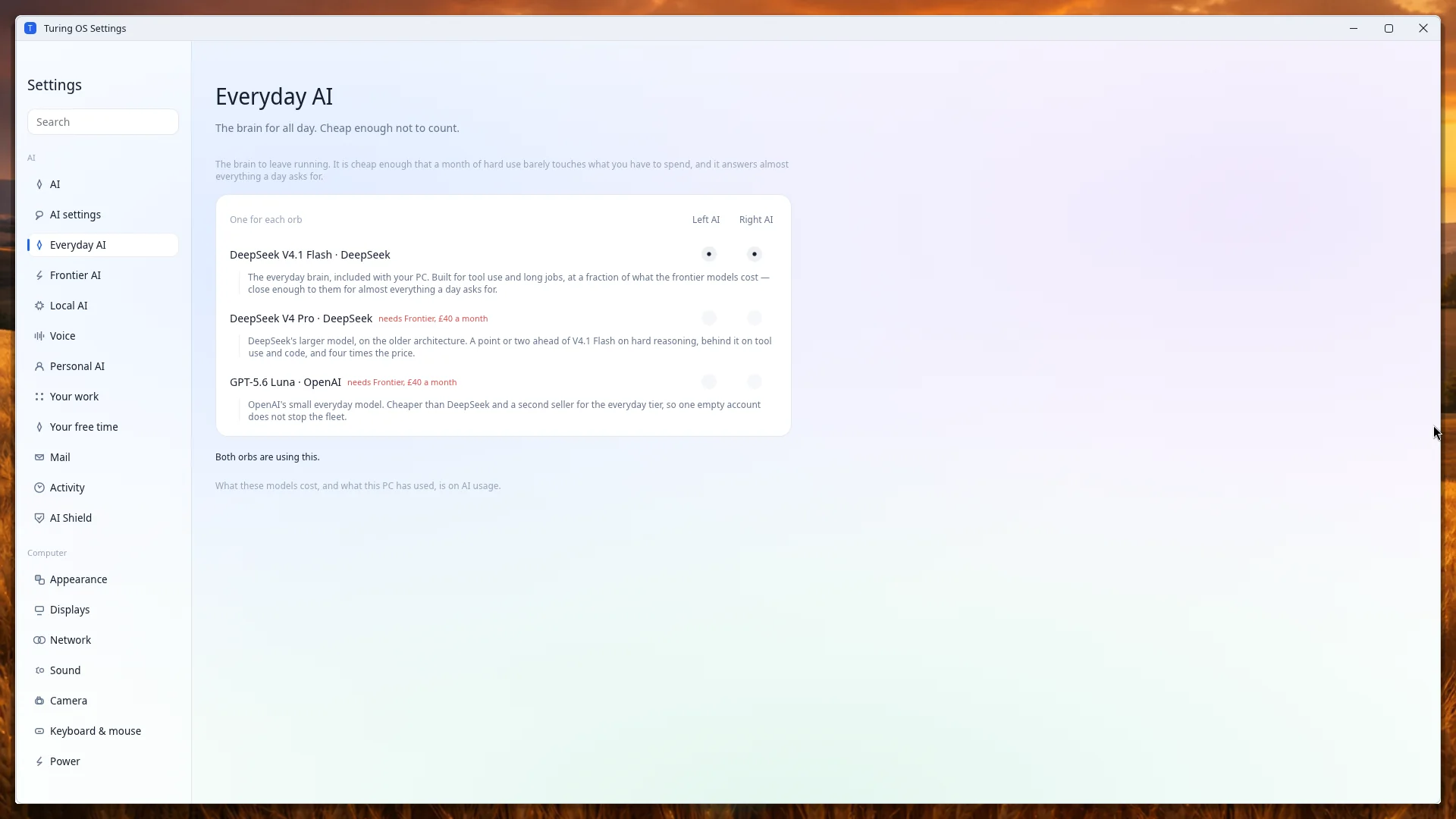
18 / 21
The model to leave running all day, chosen for each orb on the dock. DeepSeek V4.1 Flash comes with the £7.99 plan; the others here need Frontier.
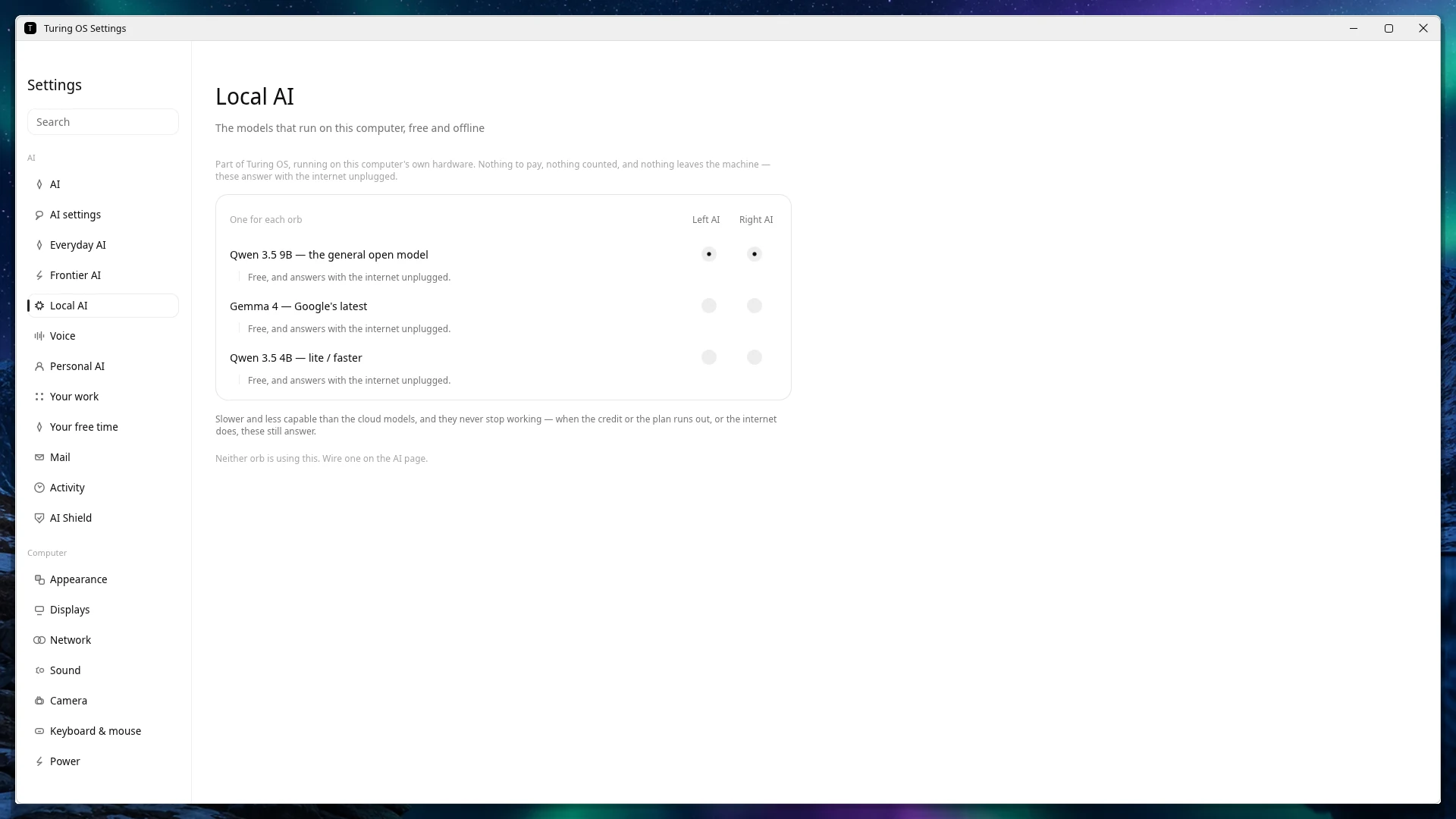
19 / 21
Models that run on your own computer: free, private, and they answer with the internet unplugged.
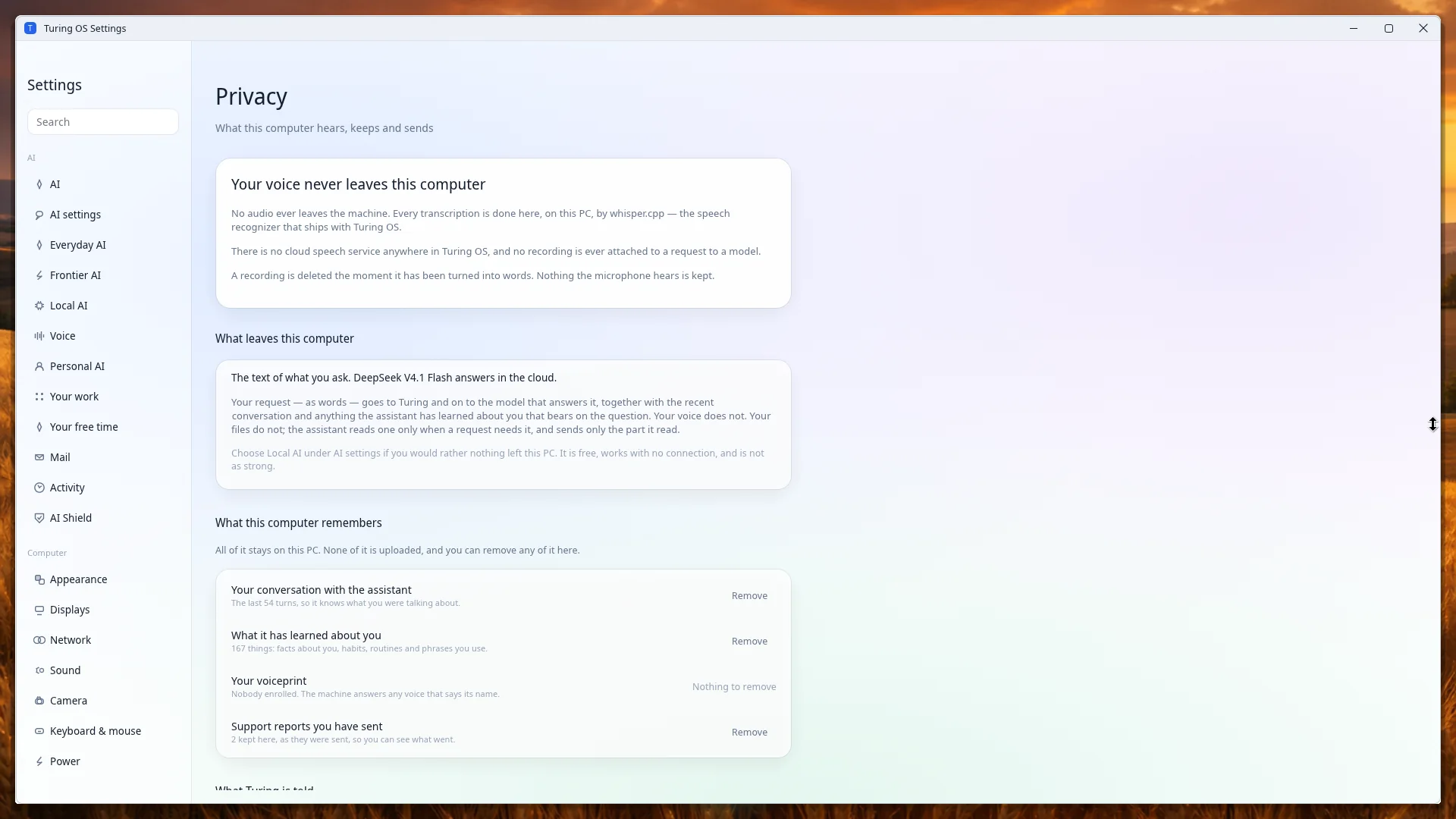
20 / 21
What this computer hears, keeps and sends, in plain words — and a Remove button beside everything it remembers.
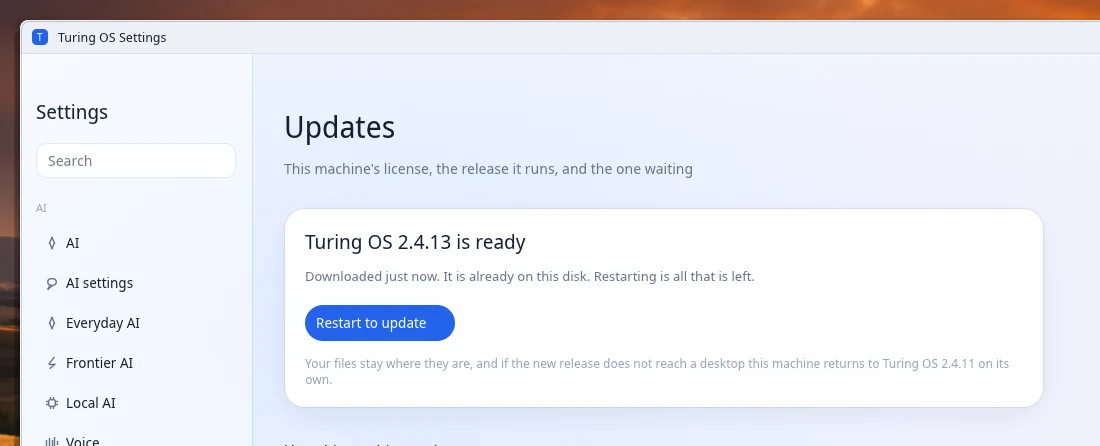
21 / 21
A new release comes every week, with improvements and security patches. The computer fetches it by itself, so the only thing left to you is when to restart. Your files stay where they are, and if a new release does not reach a desktop the computer goes back to the one before on its own.
The first 100 licenses
Select your computer’s make, install the OS, run ten short checks and send us the diagnostics (stripped of personal data) with one click of a button — and the license is yours to keep.
Download the image — it is free, with no code and no checkout — and install it on a spare computer, or beside Windows.
Under AI there is “Beta testing license”. Press “Become a beta tester”: the computer tells us its make and model, and if a place for that make is open the assistant switches on straight away.
Ten short checks within 14 days — sound, the microphone, the voice, Bluetooth, sleep. One button then sends what the computer is made of and what went wrong on it — never your files, your mail or your voice — and the license is yours for good. Everything the test involves.
Talking to it
“Hey Turing”
Or give it a name of its own — Emma, Alice or George. It starts listening the moment it hears the name, and starts working as soon as you stop speaking.
Super key
Tap the Super key and speak — or tap it and just start typing, when you would rather not talk out loud. The orb on the dock works the same way. Where to find it.
Interrupt it
Say its name while it is working or talking and it stops to ask what you want to add, then carries on with the request as you have changed it.
It waits for you
Stop to think in the middle of a sentence and it waits. A pause is not the end of what you were saying.
It knows your voice
Voice Sync learns how you speak from ordinary use, with no training session to sit through, so it hears you better the longer you have it.
In your language
Choose a voice and the computer speaks and listens in that voice’s language. Hear the voices.
It sits in the bottom row of almost every PC keyboard, between Ctrl and Alt, with four little squares printed on it. On Turing AI OS it is the key you talk to the assistant with. On a Mac keyboard it is the ⌘ Command key.
Held down with another key it is still a shortcut key, as it always was — only a tap on its own opens the microphone.
Press play. Every voice runs on the machine, with no connection needed. The voice you choose also sets the language it listens and replies in.
warm British
“Hello. This is Emma, a warm British voice for Turing AI OS.”
crisp British
“Hello. This is Alice, a crisp British voice for Turing AI OS.”
refined British
“Hello. This is Isabella, a refined British voice for Turing AI OS.”
measured British
“Hello. This is George, a measured British voice for Turing AI OS.”
professional soft
“Hello. This is Cori, a professional soft voice for Turing AI OS.”
profesionalni studio
“Živjo. Tukaj je Artur, profesionalni studijski glas za Turing AI OS.”
profesionalni jasen
“Dobro jutro. Tukaj je Artur, jasen profesionalni glas za Turing AI OS.”
profesionalni topel
“Lep pozdrav. Tukaj je Artur, topel profesionalni glas za Turing AI OS.”
profesionalni živahen
“Živjo. Tukaj je Artur, živahen profesionalni glas za Turing AI OS.”
profesionalni umirjen
“Dober dan. Tukaj je Artur, umirjen profesionalni glas za Turing AI OS.”
voz profesional
“Hola. Soy Dora, una voz profesional para Turing AI OS.”
voz clara
“Hola. Soy Alex, una voz clara para Turing AI OS.”
voz grave
“Hola. Soy Santa, una voz grave para Turing AI OS.”
voix Kokoro
“Bonjour. Je suis Siwis, une voix professionnelle pour Turing AI OS.”
professionnelle chaude
“Bonjour. Voici Camille, une voix professionnelle chaude pour Turing AI OS.”
professionnel clair
“Bonjour. Voici Bastien, une voix professionnelle claire pour Turing AI OS.”
professionnelle douce
“Bonjour. Voici Colette, une voix professionnelle douce pour Turing AI OS.”
professionnel posé
“Bonjour. Voici Damien, une voix professionnelle posée pour Turing AI OS.”
professionnelle vive
“Bonjour. Voici Élise, une voix professionnelle vive pour Turing AI OS.”
professionell hell
“Guten Tag. Das ist Anna, eine helle professionelle Stimme für Turing AI OS.”
professionell tief
“Guten Tag. Das ist Bernd, eine tiefe professionelle Stimme für Turing AI OS.”
professionell warm
“Guten Tag. Das ist Clara, eine warme professionelle Stimme für Turing AI OS.”
professionell ruhig
“Guten Tag. Das ist Dieter, eine ruhige professionelle Stimme für Turing AI OS.”
professionell klar
“Guten Tag. Das ist Elke, eine klare professionelle Stimme für Turing AI OS.”
professioneel helder
“Hallo. Dit is Saskia, een professionele heldere stem voor Turing AI OS.”
professioneel diep
“Hallo. Dit is Bram, een professionele diepe stem voor Turing AI OS.”
professioneel warm
“Hallo. Dit is Chantal, een professionele warme stem voor Turing AI OS.”
professioneel rustig
“Hallo. Dit is Daan, een professionele rustige stem voor Turing AI OS.”
professioneel zacht
“Hallo. Dit is RDH, een professionele zachte stem voor Turing AI OS.”
voce naturale
“Ciao. Sono Sara, una voce professionale per Turing AI OS.”
voce chiara
“Ciao. Sono Nicola, una voce chiara per Turing AI OS.”
warm natural
“Hello. This is Heart, a warm natural voice for Turing AI OS.”
bright expressive
“Hello. This is Bella, a bright expressive voice for Turing AI OS.”
professional clear
“Hello. This is Sarah, a professional clear voice for Turing AI OS.”
steady grounded
“Hello. This is Michael, a steady grounded voice for Turing AI OS.”
deep resonant
“Hello. This is Fenrir, a deep resonant voice for Turing AI OS.”
warm conversational
“Hello. This is Nicole, a warm conversational voice for Turing AI OS.”
professional clear
“Hello. This is Lyra, a professional clear voice for Turing AI OS.”
professional warm
“Hello. This is Kristin, a professional warm voice for Turing AI OS.”
professional deep
“Hello. This is Norman, a professional deep voice for Turing AI OS.”
professional steady
“Hello. This is John, a professional steady voice for Turing AI OS.”
professional narrative
“Hello. This is Story, a professional narrative voice for Turing AI OS.”
voz natural
“Olá. Eu sou a Dora, uma voz profissional para o Turing AI OS.”
voz clara
“Olá. Eu sou o Alex, uma voz clara para o Turing AI OS.”
स्पष्ट हिंदी
“नमस्ते। मैं अल्फा हूँ, ट्यूरिंग ओएस के लिए एक पेशेवर आवाज़।”
स्थिर हिंदी
“नमस्ते। मैं ओमेगा हूँ, ट्यूरिंग ओएस के लिए एक स्थिर आवाज़।”
自然な声
“こんにちは。チューリングOSの声、アルファです。”
落ち着いた声
“こんにちは。チューリングOSの声、クモです。”
沉稳男声
“你好。我是云希,图灵操作系统的专业声音。”
The voices are open models, several of which ask for credit — who made them, and under what license, is under Licenses in the footer.
Turing Brain
A model on its own can only write. Turing Brain is what stands between it and your computer — a harness, or a robot, as some people call it. It is the same whichever model you choose, and it is what does the work.
Reflexes
Switching desktop, setting a timer, adding up a sum: it knows these the moment you have said them, and does them without waiting for a model to think.
Meaning analysis
There are no commands to learn. It works out what a sentence means however you put it, in the language your voice speaks.
General intelligence
Anything a reflex does not catch goes to the model you chose. It plans the steps and uses the apps, and it is checked: a reply that claims something no action did is sent back.
Personalization
Your habits, your corrections and what you have told it are kept on this computer and handed to whichever model answers. They are yours: Settings shows them and deletes them.
Voice Sync
It gets better at hearing you from ordinary use, and it asks before it learns anybody else’s voice.
The web
It reads the web for an answer, fills a basket at a shop, and builds and looks after a website on the builder you choose. Some shops do not allow assistants; it tells you so and leaves them alone.
What you can ask
Ordinary requests to a Turing machine: what it does with each, and what it says back.
“Put AI Office on the left and my calendar on the right.”
Puts each window on its half of the screen you are looking at.
It says: “AI Office on the left, calendar on the right.”
“What have I got on Thursday?”
Reads Thursday out of your calendar.
It says: “Stand-up at nine, then your flight to Lisbon at two.”
“Turn the Lisbon notes into a document and save it as a PDF.”
Reads your notes, writes them up in AI Office with headings, and exports the PDF.
It says: “Done. It’s in Documents, as Lisbon weekend.”
“Move the dentist to Friday at ten.”
Finds the appointment in your calendar and moves it.
It says: “The dentist is now Friday at ten.”
“Find me a kettle under forty pounds.”
Asks real shops, reads the prices and ratings, and puts the options on screen.
It says: “Two under forty. The Bosch at 39.99 has the better rating. They’re on your screen.”
“Reply to Anna and say Saturday works.”
Writes the reply in Turing Mail and leaves it open for you. It never sends a letter itself.
It says: “The reply’s ready in Turing Mail. Read it and press Send.”
“Install Spotify.”
Installs it from the Turing Store and tells you where it comes from.
It says: “Downloading Spotify now. It comes from Flathub, made by Spotify AB.”
“Every weekday at eight, tell me the weather and my first meeting.”
Sets up a routine that runs on its own.
It says: “Every weekday at eight. I’ll start tomorrow.”
“Undo that.”
Everything it does is listed in Activity, and what can be undone, is.
It says: “Undone. The dentist is back where it was.”
“Set a timer for twenty minutes.”
Sets it and speaks up when it’s due.
It says: “Timer set for twenty minutes.”
“Show me the photos from the beach.”
Finds them in Album and opens them.
It says: “Here are your two beach photos, in Album.”
“Remember this layout as work.”
Remembers where every window is, so you can ask for “work” later.
It says: “Layout saved as work.”
AI Shield
An assistant that can act can also act wrongly. AI Shield is the part of Turing Brain that looks at everything the assistant does, and holds it to a short list of promises.
Signing in to an account, submitting a form on a website and adding a mail account still need your password — in a box the system draws itself, which the AI cannot fill in. If nobody types it, nothing leaves the computer.
Privacy
In the box
Each one is ours, and each gives the assistant its own way in — it writes in AI Office and books in Calendar directly, rather than pretending to click.
Yes, a full office suite — and every button in it is a command the assistant can run, so you ask for the change instead of hunting for it. It opens and saves the Word, Excel, PowerPoint and OpenDocument files you already have.
The word processor, for letters, reports and anything with headings. Saves as Word, OpenDocument, RTF or PDF.
Spreadsheets, for budgets and tables. Saves as Excel, OpenDocument or CSV.
Slides. Saves as PowerPoint or OpenDocument.
Pages laid out for print: a poster, a leaflet, a newsletter.
Edit a picture or make one. Saves as PNG, JPEG or TIFF.
Open a PDF and change the words in it — the text itself, not a note laid on top.
Texts, sheets, presentations, publications, pictures and PDFs, in one window.

The web, with your passwords and cards kept in it. The assistant reads, shops and builds in a page of its own.

Gmail, Outlook, iCloud, Yahoo, Fastmail or any IMAP account.
Day, week and month, with separate calendars for home and work.

Your photos. They stay on this computer and are never uploaded.

Where answers about the world appear: web results, news, weather, products.
How well the computer hears you, and where it learns your voice.

Records the screen to a video. The red dot on the top bar stops it.

The whole machine, including which AI thinks and which voice answers.
Thousands more install from the Store, straight from Flathub, the home of Linux desktop apps: say the name, or pick one, and it is there.
Built to be plugged into. Every Turing app has an API the assistant works it through, and an app made by anyone else can offer the assistant its own tools in the same way.
Apps from Flathub are their makers' own, unmodified, under their own licenses.
The desk
The AI
About what a film subscription costs, for an AI that runs your computer. There are three kinds of AI on a Turing machine. You choose which one thinks, and you can change your mind whenever you like. Whichever you pick, it is built into the system, so it can open your files, arrange your windows and answer out loud.
Everyday
Fast, inexpensive and good at almost everything a day asks for. It is the one the computer uses unless you choose another. £7.99 a month.
Frontier
The strongest models in the world, for hard problems and long jobs. Each answer costs more, so they come with the bigger plans, from £40 a month.
Local
Run on your own computer: free, private, and they answer with the internet unplugged. Slower and less capable than the cloud today, but improving quickly, and the system is built to take a better one when it comes. When a month’s allowance runs out, the local model takes over, so the assistant does not stop.
It comes with the license and opens every model, the strongest included, until it is spent.
£7.99 keeps the everyday AI running all month. From £40 you keep the frontier models too.
Without a plan the desk, the apps and Local AI keep working, free, for good.
Settings
Switch in Settings whenever you like. The desk, the apps and the voice stay the same; only the brain behind them changes — and you can give the dock one assistant or two, each with a brain of its own.
What it costs
The first 100 licenses are given, not sold, to the people who test it on their own computer. After that the license is bought in Settings, on the machine it is for.
The system
Free
Download it, install it, keep it.
The license
Free
Turns the assistant on, for good.
Free to the first 100 who test it on their computer
Cloud AI, after the credit
From £7.99 a month
Optional. Only if you want the cloud models.
| Plan | A month | What it is for |
|---|---|---|
| Everyday | £7.99 | DeepSeek V4.1 Flash, with far more than an ordinary month uses. The everyday AI only. |
| Frontier | £40 | Every model, including Claude Opus 5.5. About 1,800 conversations a month with Opus, enough to try the strongest models on real work. |
| Advanced | £97 | Every model, with enough for a full month of Claude Opus 5.5 as your main AI. About 4,500 conversations with Opus. |
| Max | £200 | Every model, for long jobs that run for hours on their own. About 9,000 conversations with Opus. |
Run out mid-month and a £5, £10 or £20 top-up carries you to the end of it. No plan is needed for the desktop, the apps or the local models.
How it works
The download is free. Write it to a USB stick, start the PC from it, and give Turing AI OS the whole disk — or a corner of it, beside Windows.
The license is what turns the assistant on, and it is not on sale yet. The first 100 go free to people who test Turing AI OS on their own computer.
“Emma, what have I got on Thursday?” It does the thing, on the machine, and tells you out loud. That is the whole of it.
Questions
No. Turing AI OS can install beside the system you already have — it needs 28 GB free — and the PC asks which one to start each time. Or give it the whole disk of a spare machine, which erases what was there.
The desk, the apps, the voices and Local AI all work without it. The cloud models — DeepSeek, Claude and the rest — need a connection, as they would anywhere.
It listens for its name, on the machine, the way a phone listens for “Hey Siri”. Nothing is recorded or kept, and nothing leaves the computer until you have asked it something. Then only the words of what you asked go out — never the audio.
Nothing changes. Without a plan you keep the desk, every app and Local AI; a plan is only for the cloud models, once the credit that came with the license is used up.
The top bar shows how much of this month’s AI you have used, as a percentage, and Settings shows how many more conversations that leaves with the frontier models. Every plan resets each month. Run out early and a £5, £10 or £20 top-up carries you to the end of it, or switch to Local AI, which is never counted.
It does what you ask, and what you have set it to do on a schedule. It never sends an email and never pays: it gets the letter or the checkout ready and you press the button. Signing in or submitting a form needs your password first, in a box the system draws and the AI cannot fill in. Everything it does is listed in Activity, and what can be undone, can be.
It runs on ordinary PCs, and Secure Boot can stay on. Not every make and model has been tried yet: if yours stops with an error while installing, send a photo of it to info@turing.london and we fix it. We are also looking for people to test it on their own computer, for a license in return.
There are voices for 12 countries, and the voice you choose sets the language it listens in and replies in. Hear them above.
Nowhere yet. The first 100 licenses go free to people who test Turing AI OS on their own computer — offer yours. After that it is bought in Settings, on the machine.
Get it
The install image is free — about 6 GB. Download it here.
With balenaEtcher, or Rufus on Windows. Copying the file onto the stick is not enough; these tools write it as a whole disk.
Start the PC from the stick. Take the whole disk, which erases it, or install beside the system you have — 28 GB free — and choose at each start. What installing involves.
The desktop runs without a license. The license is not on sale yet: test it on your computer and yours is free.
The launch batch of licenses has sold out.
Or invest £102 in the company on Seedrs and a license comes with it.
Test it on your computer and the license is free. We are looking for 100 machines of every make — 100 places are open.
If your machine stops with an error while installing, send a photo of it to info@turing.london. Not every make and model has been tried yet, and we fix these.